
A UL 2271 golf cart battery is a lithium pack that an accredited lab has tested against the safety standard written for batteries in light electric vehicles. That listing is the one piece of paper that tells you somebody outside the battery seller ran the pack through abuse tests before it was bolted under a seat. It says nothing about range or lifespan, and it does not make the pack approved by your cart’s maker. Both limits matter, and both come straight from the documents below.
We list golf cart dealers and battery shops across the country, so we see the same question from buyers in every state: two lithium packs at different prices, both called “certified”, and no way to tell them apart. This guide is the way to tell them apart.
TL;DR
UL 2271 is the safety standard for battery packs in light electric vehicles, now in its third edition, published and ANSI-approved on September 14, 2023. Its own scope says it does not evaluate performance or reliability, so a listed pack is a safety-tested pack, not a range promise. Six labs carry UL 2271 in their scope under OSHA’s Nationally Recognized Testing Laboratory program: CSA Group, Intertek, SGS, TUV Rheinland, TUV SUD, and UL. A certificate on the cells is not a certificate on the pack, and a certificate on the pack is not approval from the cart maker: E-Z-GO’s 2021 service bulletin tells owners not to fit non-approved lithium systems at all. Ask any dealer three things: which lab, which edition, and whether the vehicle maker approves that pack for that cart.
What Does UL 2271 Actually Cover?
The standard covers the battery pack and the modules inside it, for light electric vehicles, and only their safety. The standard’s first clause says it applies to “electrical energy storage assemblies (EESAs) such as battery packs” and the subassemblies that make them up, “for use in light electric-powered vehicles (LEVs) as defined in this standard.” The next clause draws the line most buyers miss: “This standard does not evaluate the performance or reliability of these devices.”
That second sentence is worth reading twice.
A pack can pass every test in UL 2271 and still deliver less range than its label claims, or lose capacity faster than a rival. The listing answers one question, which is whether the pack was built and tested to resist fire, short circuits, overcharge, and the other failure modes the standard describes. Range, cycle life, and warranty are separate questions with separate answers.
The scope also names what UL 2271 is not for. Batteries for on-road passenger vehicles “intended for use on public roadways including highways”, and heavy off-road machines such as battery-powered ride-on industrial trucks, belong under a different standard, UL 2580. Light electric rail batteries go to UL 1973.
| What the scope says | What it means at the dealer counter |
|---|---|
| Covers battery packs, modules and subassemblies for light electric vehicles | The pack as sold is what gets tested, not one cell from it |
| Does not evaluate performance or reliability | A listing tells you nothing about range, cycles, or capacity fade |
| Excludes on-road passenger vehicles and heavy off-road industrial trucks | Those packs belong under UL 2580 instead |
| Defines “light electric vehicle” inside the standard | The full definition sits behind the paywall, so ask the seller how the lab classified the pack |
All four rows come from the public scope that UL Standards and Engagement publishes for ANSI/CAN/UL/ULC 2271. The full standard costs between $505 and $1,258 depending on format, which is why almost nobody shopping for a cart has read it. The certificate is the buyer’s shortcut, and it only works if the certificate is real and names the right product.
Cell, Pack or Car Battery: Three Standards That Show Up on Spec Sheets
Lithium battery listings online tend to stack standards together, and three numbers turn up again and again on golf cart packs. They test different things.
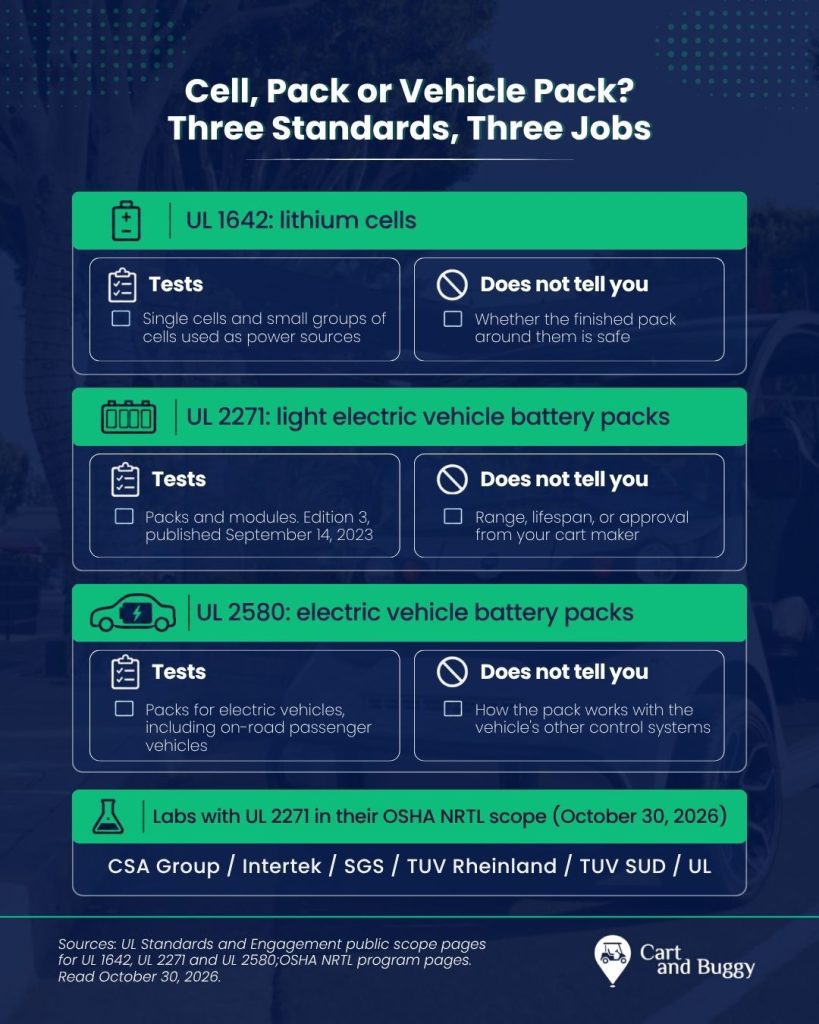
UL 1642 is the standard for lithium batteries in general, and its scope covers anything from “a single electrochemical cell” to a few cells connected, as power sources in products. Clause 1.3 of UL 1642 says “the final acceptability of these batteries is dependent on their use in a complete product that complies with the requirements applicable to such product.” In plain terms, cells that pass UL 1642 still need the finished product around them to be judged on its own. A pack built from listed cells has not, by that fact, been tested as a pack.
Then there is the pack standard for light electric vehicles, UL 2271, described above.
The third, UL 2580, covers battery packs for electric-powered vehicles more broadly. Its scope says it “evaluates the electrical energy storage assembly’s ability to safely withstand simulated abuse conditions” and judges the pack against the maker’s own charge and discharge limits at stated temperatures. It also says it “does not evaluate the assembly’s interaction with other control systems within the vehicle,” and, like UL 2271, it does not evaluate performance or reliability. The current UL 2580 was published March 11, 2020, with its last revision on June 28, 2022.
| Standard | What gets tested | What a pass does not tell you |
|---|---|---|
| UL 1642 | Lithium cells and small cell groups | Whether the finished pack around those cells is safe |
| UL 2271 | Packs and modules for light electric vehicles | Range, lifespan, or whether your cart maker approves the pack |
| UL 2580 | Packs for electric vehicles, including on-road passenger vehicles | How the pack works with the vehicle’s other control systems |
The cell certificate trap
The most common mix-up we see in seller descriptions is a line about “UL certified cells” sitting next to a photo of a finished 48-volt pack. That sentence may be true and still say nothing about the pack. The battery management system, the wiring, the enclosure, and the charger interface are where many failures start, and those parts are what a pack-level test looks at. If the paperwork names a cell maker and UL 1642, the pack question is still open.
What the 2023 Edition Added to the Test List
Edition 3 of UL 2271 is the active one, and the summary of changes UL Standards and Engagement publishes alongside it lists new tests that bear directly on how golf cart packs get charged and used. A certificate that names an earlier edition was issued against a test list that did not include these items:
- A High Rate Charge Test, which “evaluates the safety when charging at a rate higher than the specified maximum level.”
- An Overload Under Discharge Test, replacing the old “soft short” step inside the short circuit test.
- A Single Cell Failure Design Tolerance Test for large-size batteries.
- Requirements for packs built with repurposed batteries.
- A grounding continuity test.
- Updated functional safety criteria, plus a production-line check of the active controls that every unit relies on for safety.
The first item matters most to anyone fitting a lithium pack to an older cart, since a pack may end up on whatever charger is plugged into the cart receptacle.
None of this tells you that an older certificate is invalid.
It tells you that the edition number on the paperwork is a fair question, and that a seller who can answer it quickly has probably seen the certificate.
Who Is Allowed to Certify a Pack to UL 2271?
Any lab that OSHA has recognized as a Nationally Recognized Testing Laboratory (NRTL) for UL 2271 can certify a pack to it, and UL is only one of them. OSHA keeps a list of test standards it accepts under the NRTL program, and UL 2271 is on that list. Each lab then has its own scope, and when we read every lab’s OSHA scope page on October 30, 2026, six of them carried UL 2271:
| Lab named on OSHA’s NRTL pages | Scope includes UL 2271 |
|---|---|
| CSA Group Testing and Certification Inc. | Yes |
| Intertek Testing Services NA, Inc. | Yes |
| SGS North America, Inc. | Yes |
| TUV Rheinland of North America, Inc. | Yes |
| TUV SUD America Inc. | Yes |
| UL LLC | Yes |
This is why “UL 2271” and “UL listed” are not the same phrase. A pack can be certified to UL 2271 by Intertek or TUV and carry that lab’s mark instead of the UL mark. That is a legitimate certification. What makes it checkable is that the lab’s name and a file or certificate number appear on the paperwork, so you can look the product up.
OSHA’s list of appropriate test standards also explains that each lab’s scope sits on its own informational page, and most of those pages link to the lab’s certification listing database. That gives a buyer a route from a certificate number to the lab’s own record without trusting the seller’s screenshot.
Checking a certificate in practice
Ask the seller for the lab name, the certificate or file number, and the exact model number of the pack. Search that number in the lab’s listing database. The model on the lab’s record should match the model on the pack label, including the voltage and capacity. A mismatch, or a certificate issued to a different company than the one selling the pack, is worth a phone call before any money changes hands.
Reading the Words on a Listing, a Label and a Spec Sheet
Battery sellers use a handful of phrases that sound alike and mean different things. We read a lot of dealer and seller copy while maintaining our listings, and this is the plain reading we apply to each phrase. It is trade practice, not a quote from the standard.
| Phrase on the listing | How we read it |
|---|---|
| “Certified to UL 2271” with a lab named | The strongest form. Look it up |
| “Meets UL 2271” or “designed to UL 2271” | A claim by the seller about its own product. Ask whether a lab issued a certificate, and which one |
| “Tested to UL 2271” | A test may have happened, at a lab or in house. Without a certificate, nobody outside the company has signed off |
| “UL certified cells” | A statement about cells, as covered above. The pack is still untested by that sentence |
| “UN 38.3” | A transport test for shipping lithium batteries. It is about getting the pack to you, not about how it behaves in your cart |
Two smaller checks round this out. The label on the pack itself should carry the same model number as the certificate. A certification mark on a box but not on the pack, or on a website but not on either, leaves the claim unproven.
A Listed Pack Can Still Be the Wrong Pack for an E-Z-GO
A UL 2271 listing judges the battery. It does not judge the cart the battery goes into, and that gap is where conversion kits run into trouble. The plainest statement of the problem comes from a vehicle maker.
On January 27, 2021, Textron Specialized Vehicles issued E-Z-GO field service bulletin 01-21 on non-approved lithium battery conversions. It applies to all of the company’s electric vehicles, including E-Z-GO, Cushman, Jacobsen, Arctic Cat, Tracker, Bad Boy Buggies, and Textron Off Road. The bulletin says non-approved lithium systems “use a charger that may not be compatible with the factory/OEM charger receptacle and may exceed the capacity of the receptacle,” and that the result can include damage to the receptacle, the vehicle’s electrical system and the surroundings, and “injury or death.”
Its instructions are blunt.
| E-Z-GO bulletin 01-21 says | Why a UL 2271 listing does not settle it |
|---|---|
| Do not modify any vehicle with non-approved lithium battery systems | Approval is the vehicle maker’s call, and the standard does not grant it |
| Do not use non-approved chargers with factory charger receptacles | The failure point named is the cart’s receptacle, which is not part of the pack |
| Do not modify the charger receptacle in any way | A rewired receptacle changes the vehicle, not the battery |
| If the vehicle has already been modified, do not charge it and contact the lithium system’s maker | Responsibility moves to whoever sold the conversion |
E-Z-GO’s owner safety guidance makes the same point more generally: “Only authorized E-Z-GO dealers should alter the vehicle using approved parts.” Other makers may set different rules for their own carts, so the question to ask is the same for any brand. Does the cart maker approve this pack, with this charger, for this model?
For anyone weighing a conversion on a cart they already own, this is the order of questions we would use: is the pack approved by the cart maker, is the pack certified to UL 2271 by a named lab, and is the charger the one the pack maker specifies. A yes to the second without the first still leaves the cart owner holding the risk the bulletin describes.
When the cart is a registered LSV
If the cart is a registered low-speed vehicle, the battery question gets one more layer. The 2271 scope leaves on-road passenger vehicles to UL 2580, so for a street-legal build it is fair to ask the pack maker which of the two standards it was tested to, and why. Our guide to what turns a cart into a street-legal LSV covers the federal equipment side of that build.
Does Any Law Require UL 2271 on a Golf Cart?
We have not found one. The best-known rule that names UL 2271 is a New York City law signed on March 20, 2023, and it is written for micromobility. According to UL Solutions’ summary of the New York City law, it requires UL 2271 certification for “any storage battery for a powered bicycle or mobility device” sold, leased, or rented in the city, from a lab that is UL Solutions or another NRTL, with a compliance date of September 16, 2023.
Golf carts are not named in that rule.
So in most places the listing is a buyer’s choice, which is the reason to make it a deliberate one. An unlisted pack is simply a pack whose safety claims rest on the seller’s word.
Value Brands, Conversions and Used Carts: Where the Question Lands
The UL 2271 question comes up in three buying situations, and the right person to ask is different in each.
A new cart with a factory lithium pack
The pack came from the cart maker, so maker approval is not the issue. The listing still is, and the dealer selling the cart is the person to ask for the lab name and certificate number. Buyers compare value brands on price and warranty; the way our breakdown of ICON, Evolution and Star EV side by side does, can add this as one more row in the comparison. A brand that answers with paperwork is telling you something about how it sources batteries.
A conversion kit for an older lead-acid cart
Here both questions are live: the pack’s listing and the cart maker’s approval. The upside of conversion, lighter weight and less upkeep, is real, and our look at the cost and upkeep trade-off between lithium and lead-acid walks through it. The bulletin above is the reason the approval question comes first.
A used cart that already has lithium in it
The previous owner may not know what was fitted. Read the label on the pack, photograph the model number, and look up the certificate before you agree a price. If there is no label and no paperwork, price the cart as if the pack might need replacing, since how long golf cart batteries tend to last depends on a history you cannot see.
Season matters a little too. Many conversions get done over winter while carts sit, and lithium packs have their own rules for charging in the cold, which our guide to storing and charging a cart through a cold winter sets out by battery type.
Asking a Dealer for the UL 2271 Certificate Before You Pay
Every shop in our golf cart battery replacement listings, whether it sits in Indiana, Arizona or North Carolina, can be asked the same short set of questions on the phone before you drive over. Which lab certified the pack to UL 2271, and what is the certificate number? Which edition of the standard does the certificate name? Is the pack approved by the car’s maker for this model, and which charger goes with it? A shop that answers all three without hesitation has done this before.
One that cannot answer the first question has told you enough.
| Question for the dealer | A good answer sounds like |
|---|---|
| Which lab, and what number? | A named NRTL and a number you can search |
| Which edition? | Edition 3, or a clear reason it is an earlier one |
| Approved by the cart maker? | Yes, for this model, with the specified charger |
We built Cart and Buggy so buyers can find those dealers by brand and by state, and the battery category is the place to start when a lithium pack is on the list.