
The golf cart winter storage Colorado weather calls for is mostly a battery job, and it has a deadline. Denver’s average first freeze is October 7. Before that night, a lead-acid pack should be fully charged, and a lithium pack should be parked somewhere that stays at or above 32°F, because that is where the battery makers’ own documents draw their lines.
TL;DR
Denver’s freeze season runs, on average, from October 7 to May 5 in National Weather Service records that go back to 1872. What a parked golf cart needs through those seven months depends on the battery chemistry under the seat.
Flooded lead-acid: charge it full, disconnect it, read the voltage every 4 to 6 weeks, and recharge at 70 percent, per Trojan. AGM: the same idea, checked every 2 to 3 months and recharged at 75 percent. Lithium: Interstate’s manual for its 48-volt golf cart pack says to power it off above 60 percent, store it long term between 32°F and 95°F, and charge it only at 32°F or warmer.
A lead-acid battery kept fully charged will not freeze in any cold Denver has recorded. A neglected one can.
October 7 Is the Date to Work Back From
The National Weather Service office in Boulder keeps Denver’s fall, winter, and spring statistics on one page, with freeze records that run back to 1872. Its average date for the first freeze is October 7.
| Denver freeze record (NWS Boulder, since 1872) | Date |
|---|---|
| Average first freeze | October 7 |
| Earliest first freeze | September 8 (1962 and 2020) |
| Latest first freeze | November 15, 1944 |
| First freeze in the last three years | October 13, 2023; October 25, 2024; October 18, 2025 |
| Average first measurable snow | October 19 |
| Average last freeze | May 5 |
| Latest last freeze | June 8, 2007 |
An average hides the spread. In eight of the last ten years, the first freeze arrived after October 7, as late as October 25 in 2024. In 2020 it came on September 8, about a month early.
So treat October 7 as the day the battery work should already be finished. Starting on that date is a gamble on a mild fall.
One caution on geography.
These are Denver’s numbers. Fort Collins, Boulder, Castle Rock, and Colorado Springs each have their own station records, and we have not read those. Use Denver as a guide along the Front Range, and lean earlier at higher elevations.
Which Battery Is Under Your Seat?
Lift the seat and look at the tops of the batteries.
Removable caps on each cell mean flooded lead-acid, the kind that takes distilled water. A set of sealed cases with no caps is usually AGM. One large case with a power button and a gauge cable is a lithium pack. The label settles it, and each chemistry carries a different winter rule from the company that built it.
| Chemistry | What cold does to it | Maker document we read |
|---|---|---|
| Flooded lead-acid | Electrolyte can freeze if the battery is not fully charged | Trojan Battery FAQ and Trojan user’s guide (2023) |
| AGM (sealed lead acid) | The same freezing risk at low charge, with slower self-discharge | Lifeline technical manual, Concorde Battery (Revision E, 2017) |
| Lithium (LiFePO4) | Charging is off limits below 32°F, and the long-term storage range starts at 32°F | Interstate LIGC48V100 safety and operation manual |
Not sure what you bought? Day-to-day differences between lithium and lead-acid packs are covered in a separate comparison on our blog.
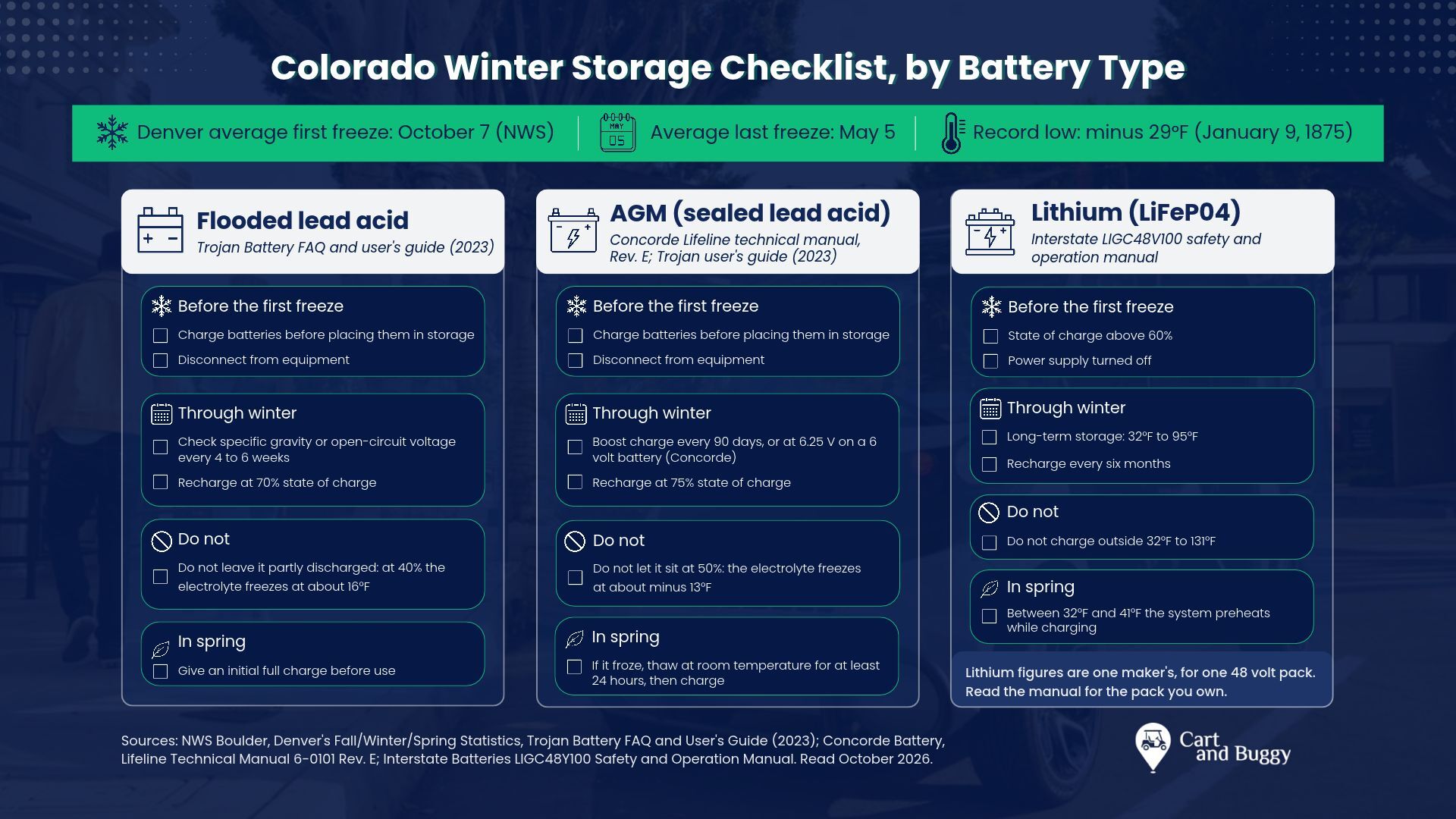
Flooded Lead Acid: Full Charge First, Then a Reading Every 4 to 6 Weeks
Trojan Battery answers the freezing question in one line on its battery FAQ page: “The only way a battery can freeze is if it is left in a state of partial or complete discharge.” The numbers follow in the same answer. Electrolyte in a fully charged battery freezes at minus 92°F. At a 40 percent state of charge it freezes at approximately 16°F.
Why such a gap? As a battery discharges, Trojan explains, the electrolyte becomes more like water.
Charge level is the whole story.
The company’s printed user’s guide for flooded, AGM and gel batteries (the 2023 edition linked from its maintenance page) turns that into a storage routine:
- Charge the batteries before placing them in storage.
- Store them in a cool and dry location, protected from the elements.
- Disconnect them from equipment so parasitic loads cannot discharge them.
- Check specific gravity or open-circuit voltage every 4 to 6 weeks.
- Recharge once a flooded battery declines to a 70 percent state of charge, per the Trojan guide.
The guide adds a plain warning for climates like ours. “If possible, avoid locations where freezing temperatures are expected during storage.”
Skipping the winter check is expensive. In our guide to what shortens a golf cart battery’s life, storing a cart over winter without maintaining the charge is listed as a common way to lose a pack early.
Two Trojan tables, one instruction
The user’s guide carries a second freezing table, credited to the BCI Service Manual and read by specific gravity. Electrolyte at 1.280 freezes at minus 92°F, at 1.200 at minus 16°F, and at 1.100 at 19°F. Set that beside the guide’s own state of charge chart, which puts 40 percent at 1.148, and a 40 percent battery lands near the table’s minus 5°F row for 1.150, well below the FAQ’s 16°F. The two Trojan documents do not line up at mid-charge. We plan around the stricter FAQ number, and both documents end on the same instruction anyway: keep it charged.
Should the charger stay plugged in?
It depends on the charger. Where batteries are infrequently used, the Trojan guide says, “it is desirable to compensate for self-discharge by keeping a low charging voltage on the batteries,” and calls that the float voltage. A charger with a float stage does that job for you. If yours has none, the 4 to 6-week reading and a recharge at the 70 percent line, per the same Trojan guide, cover it.
AGM Batteries: Sealed and Slower to Drain, but They Still Freeze Flat
Concorde Battery’s Lifeline technical manual is the most detailed AGM storage document we found. It puts AGM self-discharge at 1 to 3 percent a month at room temperature, against 5 to 10 percent for a new flooded deep cycle battery. That slower drain is why the check interval stretches.
The manual asks for a boost charge every 90 days, or sooner if the open-circuit voltage drops to 6.25 volts on a 6 volt battery, which the same manual equates to roughly 75 percent state of charge. Trojan’s guide lands in the same place for its own AGM line: a voltage check every 2 to 3 months and a recharge at 75 percent.
Sealed does not mean freeze-proof. Here is the freezing point of the electrolyte by state of charge, as Concorde prints it:
| AGM state of charge | Approximate electrolyte freezing point (Concorde) |
|---|---|
| 100% | minus 94°F |
| 75% | minus 53°F |
| 50% | minus 13°F |
| 25% | 9°F |
| 0% | 21°F |
The manual calls AGM batteries “resistant to damage by freezing temperatures,” where it lists a flooded battery as destroyed when frozen. Resistant is the word, and immune is not. A frozen battery, Concorde writes, may be permanently damaged by expansion of the electrolyte. It should thaw at room temperature for at least 24 hours before any charge, and it is out of service if the case shows cracking.
A single answer in that manual is written for sheds. Asked for the best charge voltage setting outdoors when temperature sensing is not available, Concorde replies “NONE!” and warns that batteries will fail prematurely. A charger left running all winter in an unheated building should be one that senses temperature.
Lithium Packs: The Winter Rule Sits at 32°F
Lithium turns the lead-acid logic around.
A full charge is no protection here. The trouble comes from charging a cold pack, and from leaving it for months below its rated storage temperature.
Interstate Batteries’ safety and operation manual for its 48-volt LIGC48V100 golf cart battery prints the limits in a few short lines.
| Interstate LIGC48V100 limit | What the manual says |
|---|---|
| Charging | 32°F to 131°F |
| Discharging | minus 4°F to 131°F |
| Short-term storage (within 1 month) | minus 4°F to 113°F |
| Long-term storage (within 1 year) | 32°F to 95°F |
| State of charge for long-term storage | Above 60%, with the power supply turned off |
| Maintenance recharge | Every six months |
Three details in that manual change the plan for a Colorado winter.
The long-term storage range bottoms out at 32°F, and Denver’s average freeze season lasts about seven months.
An unheated shed that follows the outdoor air will dip under that floor again and again. Charging has a cold edge too. The manual says that when a charge starts with the battery between 32°F and 41°F, the system preheats and charges at once. Below 32°F, it gives no charging range at all.
Then there is the gauge. A fully charged pack that is not in use shuts itself down after 7 days of inactivity, by the same manual. A dark display in January is expected behavior, so it is no reason to assume the pack has died.
These are one maker’s numbers for one pack.
Other lithium brands print their own, so read the storage page for the pack you own before you copy ours.
Has Denver Ever Been Cold Enough to Freeze a Stored Battery?
Yes, if the battery sat partly discharged. No, if it was kept full. Denver’s coldest reading in the NWS record is minus 29°F, on January 9, 1875. A fully charged lead-acid battery does not freeze until about minus 92°F by Trojan’s figure, or minus 94°F by Concorde’s AGM table, which leaves a margin of more than 60 degrees below anything the city has logged.
Let the charge slip and that margin is gone.
| Battery condition | Maker’s freezing point | Has Denver’s record passed it? |
|---|---|---|
| Lead-acid, fully charged | minus 92°F (Trojan), minus 94°F (Concorde AGM) | No. The record low is minus 29°F |
| AGM at 75% | minus 53°F | No |
| AGM at 50% | minus 13°F | Yes. Minus 24°F on December 22, 2022 |
| Flooded at 1.200 specific gravity | minus 16°F | Yes, on that same night |
| Flooded at 40% (Trojan FAQ) | about 16°F | Yes, by 40 degrees on that night |
On the state of charge chart in the Trojan guide, 1.200 specific gravity sits just above 60 percent, per Trojan. That is a pack an owner would call “mostly charged.”
December 22, 2022 is recent enough that most Front Range owners remember it. The official low was minus 24°F, and the NWS table of coldest daily highs shows a high of only minus 6°F that day.
Does a battery inside a shed really get as cold as the air? Not right away.
Battery temperature lags the air temperature, the Lifeline manual points out, because a battery has a large thermal mass. A lag buys you a night. It does not buy you a week, and NWS lists a stretch of 115 consecutive hours at or below zero in Denver, from December 21 to 25, 1983.
Garage, Shed or Under a Cover Outdoors
Where the cart sits matters differently for each chemistry. Charged lead-acid tolerates cold, and Trojan’s FAQ notes that cooler temperatures slow self-discharge. The Lifeline manual goes further and recommends the coolest environment available, preferably not above 68°F. Lithium is the one that wants to stay above freezing.
| Where the cart sits | Lead-acid, flooded or AGM | Lithium, by Interstate’s ranges |
|---|---|---|
| A heated or attached garage that stays above 32°F | Meets Trojan’s advice to avoid freezing locations | Inside the long-term storage range |
| An unheated detached garage or shed | Workable only if the pack is kept charged and checked | Under the long-term range on freezing nights, and no charging until the pack is back to 32°F |
| Outdoors under a cover | The cover is the only protection from the elements, and the charge rule is unchanged | The same limits, plus the minus 4°F short-term floor in a deep cold snap |
Trojan’s FAQ also retires an old garage rule. Setting a battery on a concrete floor does not drain it faster, because modern cases are made of materials “that allow a battery to be stored anywhere.”
If outdoors is the only choice, the cover does real work. An older post of ours on picking a cover by fabric and fit compares vinyl with polyester and canvas, and explains why a loose cover lets water pool.
Gas carts are not exempt
A gas cart still carries a 12 volt battery to start the engine, typically a lead-acid one, so the freezing rule above applies to it as well. Charge it, disconnect it, and read it on the lead-acid schedule.
Fuel and engine storage steps vary by engine, and we did not source those for this article, so the storage section of the owner’s manual is the document to follow. For the other ownership differences, see how gas and electric carts compare.
The Midwinter Check: One Voltage Reading for Each Battery
Open-circuit voltage is the reading taken with nothing connected and the battery rested. Concorde specifies at least 4 hours of rest for a true number. The recharge lines below come from the state of charge charts in Trojan’s user’s guide.
| Battery | Full charge | Recharge at or below |
|---|---|---|
| Flooded 6 volt | 6.37 V | 6.19 V (70%) |
| Flooded 8 volt | 8.49 V | 8.25 V (70%) |
| Flooded 12 volt | 12.73 V | 12.37 V (70%) |
| AGM 6 volt | 6.42 V | 6.27 V (75%) |
| AGM 8 volt | 8.56 V | 8.36 V (75%) |
| AGM 12 volt | 12.84 V | 12.54 V (75%) |
For its own 6-volt AGM, Concorde draws the line at 6.25 V, a shade lower. Small differences like that are the reason to use the chart from the company that built your battery.
Put the checks on a calendar now. Counting from an October 7 park date, a 6-week interval puts flooded readings in mid-November, late December, early February, and late March. An AGM pack on a 90-day interval gets a look in early January and again in early April. Lithium owners have a single date to mark. Interstate recommends a recharge every six months, and a Denver storage season runs about seven. A pack parked in early October comes due in early April, a month before the average last freeze, so pick a day when the pack itself is at 32°F or warmer.
When Is It Safe to Wake the Cart Up?
Later than the first warm weekend suggests. Denver’s average last freeze is May 5, and the NWS record shows one as late as June 8, 2007. Over the last ten years, the final freeze has landed anywhere from April 23 to May 22.
A charged lead-acid pack barely cares about the date.
A lithium pack does care, because the date decides when you can plug in.
- Lead-acid, flooded or AGM: Trojan’s guide asks for an initial full charge when batteries come out of storage, before use.
- Flooded only: look in each cell first. The electrolyte level should not drop below the top of the plates, according to Trojan’s FAQ.
- Lithium: charge once the pack is inside Interstate’s 32°F to 131°F range. Between 32°F and 41°F, the manual says the system preheats while it charges.
After the pack is sorted, our ten-point maintenance list covers tires, brakes, and the yearly service visit.
Line Up Winter Storage Help From a Colorado Dealer Now
We are a directory, so we will not be the ones charging your pack in January. What we can do is shorten the search for a shop that will.
Our Colorado page says most full-service dealers in the state handle seasonal storage and winterization, and that most Colorado owners store their carts from late fall through early spring. Listings there include shops in Fort Collins, Windsor, Parker, Castle Rock, and Colorado Springs.
Before you call the golf cart dealers in Colorado nearest you, have three answers ready: the battery chemistry, the voltage of each battery, and where the cart will sit. Then ask what their storage service does about state of charge, and how often.
Compare the answers on Cart and Buggy, and choose the shop whose routine matches the document your battery maker wrote.