
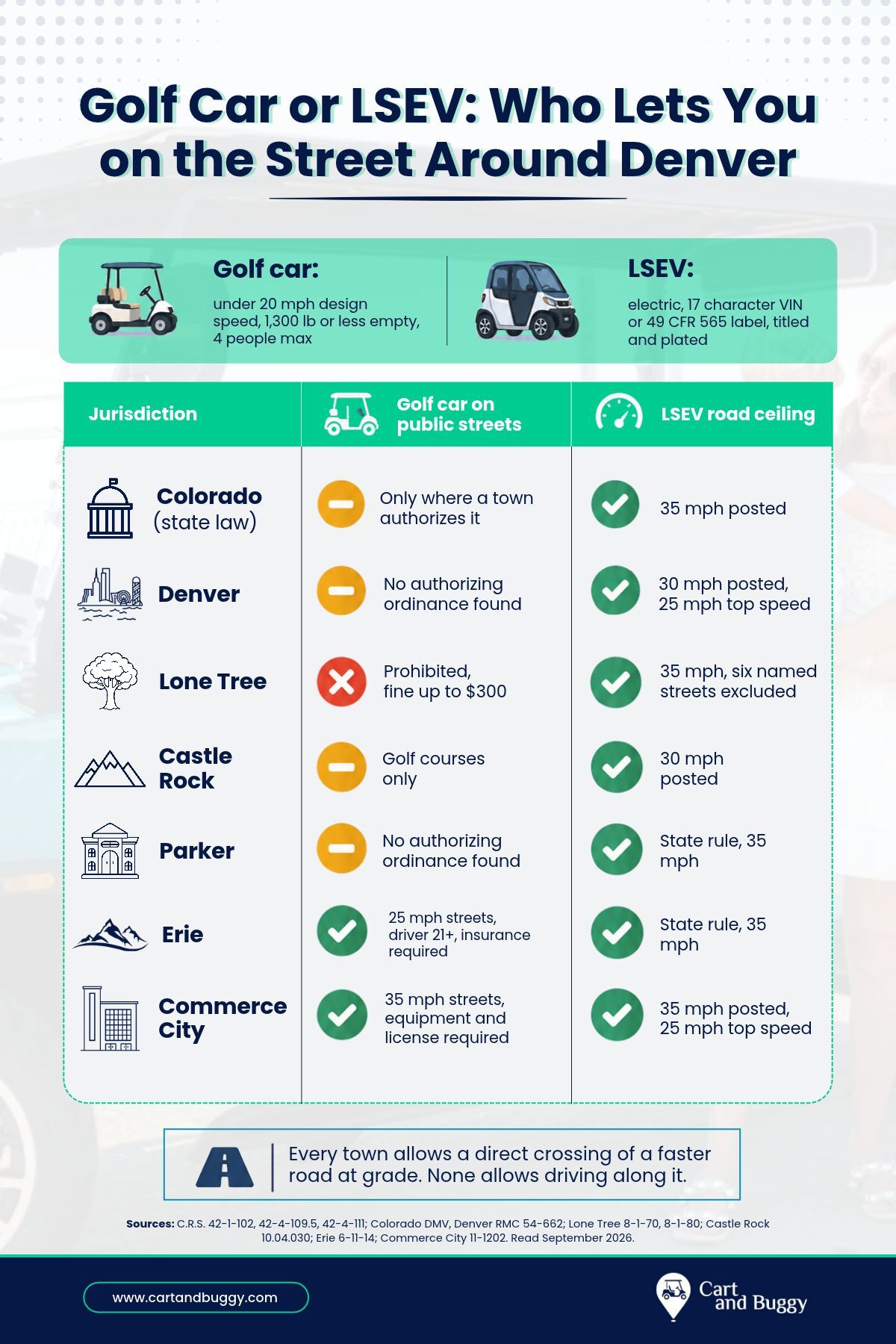
Street legal golf carts in Denver are really low-speed electric vehicles, and the city holds them to a tighter line than the state does. Colorado lets an LSV use roads posted 35 mph or less. Denver’s own code cuts that to 30 mph. A plain golf car, the kind built for the course, has no Denver ordinance putting it on a public street at all, and the towns around Denver each wrote their own answer.
TL;DR
Colorado splits these vehicles in two. A golf car has a design speed under 20 mph and cannot be titled for the road. A low-speed electric vehicle (LSEV) is titled and plated through the county, most often as a Tax Class C vehicle.
Inside Denver, Revised Municipal Code section 54-662 keeps an LSEV off any street posted above 30 mph, caps its speed at 25 mph, and bars it from controlled-access highways. Denver’s 20 mph default on unstriped residential streets means most neighborhood blocks qualify.
Golf cars are a different story: we found no Denver section authorizing them on streets. Lone Tree bans golf cars outright. Castle Rock limits them to golf courses and its LSEVs to 30 mph roads. Erie and Commerce City allow golf cars on slower streets with equipment, license and, in Erie, insurance rules.
Golf Car or LSEV Decides Everything Else
Colorado law does not have a category called “street legal golf cart.” It has two separate vehicles, and which one you own settles where you can drive before any town gets a say.
State law (C.R.S. 42-1-102(39.5)) defines a golf car as a self-propelled vehicle not built mainly for roadways, with a design speed under 20 mph, at least three wheels on the ground, an empty weight of 1,300 pounds or less, and room for no more than four people. That describes most stock carts. If you are not sure where yours falls, our piece on how fast a stock cart actually goes covers the speed side.
The Colorado DMV’s low-speed electric vehicle page sets out the other category. An LSEV runs on electricity as its main power, keeps at least three wheels on the ground, does not steer with handlebars, and either carries the manufacturer’s compliance with 49 CFR 565 or displays a 17-character VIN. The DMV says most are titled and registered as Tax Class C vehicles, get passenger plates, and are handled at the county motor vehicle office.
| Golf car | Low-speed electric vehicle | |
|---|---|---|
| Design speed | Under 20 mph | Street use is capped by roads, and at 25 mph in Denver |
| Power | Gas or electric | Electric as the primary power |
| Title and plates | Not for road use | Titled, registered, passenger plates |
| Street access comes from | A town ordinance, if one exists | State law, then local limits |
One detail catches gas owners.
Because the DMV definition requires electricity as the primary propulsion method, a gas cart cannot become an LSEV in Colorado no matter how much equipment you bolt on.
Why Does Denver Set a Lower LSV Ceiling Than Colorado?
The city wrote its own number. Revised Municipal Code section 54-662 says a neighborhood electric vehicle or LSEV “shall not be operated upon any street or highway that has a posted speed limit in excess of thirty (30) miles per hour.” The state statute, C.R.S. 42-4-109.5, uses 35. Inside the City and County of Denver, the 30 mph line is the one that applies.
Most published guides to Denver repeat the 35 mph state figure. We read the Denver code itself in September 2026, and Denver Revised Municipal Code section 54-662 lists four conditions:
- Streets and highways posted above 30 mph are off limits, though you may cross one at an intersection.
- Controlled-access highways are closed to LSEVs.
- Top operating speed is 25 mph.
- Riders and load stay within what the manufacturer specifies, with everyone seated in seats like the factory ones.
The sections around it matter too. Section 54-660 lets anyone licensed to drive in Colorado (or exempt from licensing under state law) operate an LSEV on city streets. Section 54-661 applies every state traffic law to those drivers, and names financial responsibility, which is Colorado’s insurance requirement, specifically.
The 20 mph rule works in your favor
The city changed its default speed on local streets from 25 mph to 20 mph. Denver’s 20 mph local speed limit page describes local streets as the unstriped roads through residential blocks, and says the city replaced or installed nearly 2,700 signs. Where no sign is posted, 20 mph is the limit.
So the typical Denver neighborhood block sits well under the 30 mph ceiling.
The trouble starts at the edges. Striped arterials are posted individually, and many run above 30, which means your LSEV can cross them at an intersection but cannot drive along them.
Can a Plain Golf Car Use Any Denver Street?
Not under any ordinance we could find.
State law, in C.R.S. 42-4-111(1)(bb), lets a city or town authorize golf cars on its roadways by ordinance or resolution. The city has not used that power in its municipal code. The only golf cart section that came up in our September 2026 search of the Denver code was a parks rule (section 39-23) about how carts are driven on city golf courses.
That leaves a course-spec cart where the state leaves it: on private property, on a golf course, and inside communities whose roads are private and whose own rules allow it.
A cart that runs 19 mph with no VIN is a golf car, whatever accessories it wears.
Westminster, on Denver’s northwest edge, shows how some neighbors handle the crossing problem. Its code (section 10-1-14) lets a golf cart go onto a highway only to cross in a designated crosswalk, and while crossing it has the same rights and duties as a pedestrian.
Lone Tree, Castle Rock and Parker Each Wrote Something Different
Douglas County holds three of the clearest examples in the metro.
Same county, three answers.
Lone Tree takes the hardest line on golf cars. Lone Tree Municipal Code section 8-1-80 says driving a golf car on any public street, roadway, or highway in the city “is not authorized and is prohibited,” with a fine of up to $300. LSEVs get more room. Section 8-1-70 allows them on city streets posted 35 mph or less, except six named roads: Chester Street, County Line Road, Lincoln Avenue, Park Meadows Center Drive, RidgeGate Parkway and Yosemite Street.
Lone Tree’s LSEV section also lists its own equipment floor: headlamps, front and rear turn signals, tail lamps and stop lamps, a rear-view mirror or mirrors, and a parking brake. The driver needs a valid license or minor driver’s license, and riders are limited to the number of seats.
Castle Rock amended the state traffic code in section 10.04.030. Its version of the LSEV rule says golf cars do not qualify as low-speed electric vehicles, and it drops the road ceiling to 30 mph, the same as Denver. Golf cars themselves may be operated only within golf courses, apart from the town’s own business use, and never on public streets, paths, trails, sidewalks or greenbelts.
Parker is the quiet one. We found no section of Parker’s municipal code authorizing golf cars on town streets. The golf car references we did find are narrow: a crossing allowance for play between holes at the Black Bear golf course, and a parks section stating that no other provision of the code authorizes golf cars on park lands, trails, or sidewalks. We also found no Parker change to the LSEV rule, so the state’s 35 mph limit is the one to plan around there.
| Town | Golf car on public streets | LSEV road ceiling |
|---|---|---|
| Denver | No authorizing ordinance found | 30 mph posted, 25 mph top speed |
| Lone Tree | Prohibited, fine up to $300 | 35 mph, six named streets excluded |
| Castle Rock | Golf courses only | 30 mph |
| Parker | No authorizing ordinance found | State rule, 35 mph |
Where Golf Cars Are Allowed on Town Streets
Two towns in our research went the other way and wrote golf cars into their street codes. Neither made it casual.
Erie, north of Denver, allows golf cars under section 6-11-14 of its code. The conditions are specific:
- Streets posted 25 mph or less, plus Mountain View Boulevard, with direct crossings of faster roads allowed at grade.
- A driver who holds a valid license and is 21 or older.
- Nine items of equipment, including headlamps, turn signals, a windshield, seat belts for every occupant, two rear reflectors, and a slow-moving vehicle sign on the back.
- No more than four people, and child passengers in the restraint state law requires.
- Section 6-11-14 requires liability insurance of at least $100,000 for property damage, $100,000 for injury to one person, and $300,000 for all persons in one accident.
- No town paths or trails.
Erie also lets an owner who lives on a street too fast for golf cars drive the shortest route between home and the nearest allowed street.
That clause is rare, and it solves a real problem.
Commerce City, in Adams County, handles golf carts and LSEVs in one amended section (11-1202). A golf cart on a roadway needs a windshield, headlamps, taillamps and reflectors, stop lamps and turn signals, a horn, and mirrors. Neither vehicle may use a road posted above 35 mph except to cross, go faster than 25 mph, or carry more than the manufacturer allows, and the driver needs a valid license.
The Commerce City section adds a lane rule we have not seen elsewhere in the metro. Golf carts and LSEVs keep to the right-hand lane, and where a bike lane or a paved shoulder suitable for bikes exists, they drive there.
Crossing a Faster Road Without Breaking the Rule
Every code above allows the same exception: cross a faster road directly, at grade, to keep going on a slower one. None allows a short run along it to reach the next turn.
On the Front Range, that often decides the whole route, because four-lane arterials cut neighborhoods into pockets. State law (C.R.S. 42-4-109.5) opens one narrow door for LSEVs on 40 mph state highways, only where lanes are at least 11 feet wide, there are two or more lanes each way, and the Colorado Department of Transportation has found it safe.
Treat that as a road-by-road exception. Our list of safety habits for mixed traffic is worth reading before the first trip across an arterial.
How to Check Your Own Route Before You Buy
Work out the route first, then the cart.
Buyers who do it the other way round end up with a vehicle they can only use on half their errands.
- Find your town. Denver, Lone Tree, Castle Rock, Parker, Erie, and Commerce City all answer differently, and an unincorporated address falls under the county rather than a city.
- Read your town’s traffic code for “golf car” and “low-speed electric vehicle.” Most metro codes are published online and searchable.
- Write down the posted limit on every road you plan to use, and mark each one that is only a crossing.
- Compare those limits with your town’s ceiling: 30 mph in Denver and Castle Rock, 35 mph under state law, 25 mph for golf cars in Erie.
- Decide the vehicle. If the route needs public streets and your town has not authorized golf cars, you are shopping for an LSEV.
- Budget for the county title and registration, and for insurance, before you settle on a price.
If the answer is an LSEV, our walkthrough of the equipment an LSEV conversion involves, and our guide to the title and registration steps, cover what comes next. Converting a used golf cart is not always the cheaper path, because the VIN and equipment requirements are what separate the two categories in the first place.
Ask a Colorado Dealer the Street Question First
Late September is a sensible time to settle this. Our Colorado directory page notes that most owners store carts from late fall through spring, so a purchase now is usually about next season’s routes.
The dealers in our listings for Colorado golf cart dealers are concentrated around the Denver metro, including Commerce City, Centennial, Aurora, Parker, and Castle Rock. Before you talk price, ask each one three things.
Is this vehicle a golf car or an LSEV under Colorado law? Does it carry a 17-character VIN? What does it take to title it in your county?
A dealer who answers those plainly has sold street vehicles in this state before. We built Cart and Buggy so you can compare those shops side by side and contact them directly, without guessing which ones know the Denver rules from the state ones.