
To register a golf cart as a low-speed vehicle, you need a cart that meets LSV equipment rules and carries a 17-digit VIN, proof of ownership, proof of insurance in most states, and a visit to your state motor vehicle office to title and plate it. Many dealers handle most of this for you when the cart is sold as street legal. The exact steps vary by state, so treat this as the general path and confirm the details for where you live.
This guide walks through each step, what it costs, how long it takes, and why buying a street-legal cart from a dealer is the easy route.
The registration process, step by step
Step one: confirm the cart qualifies
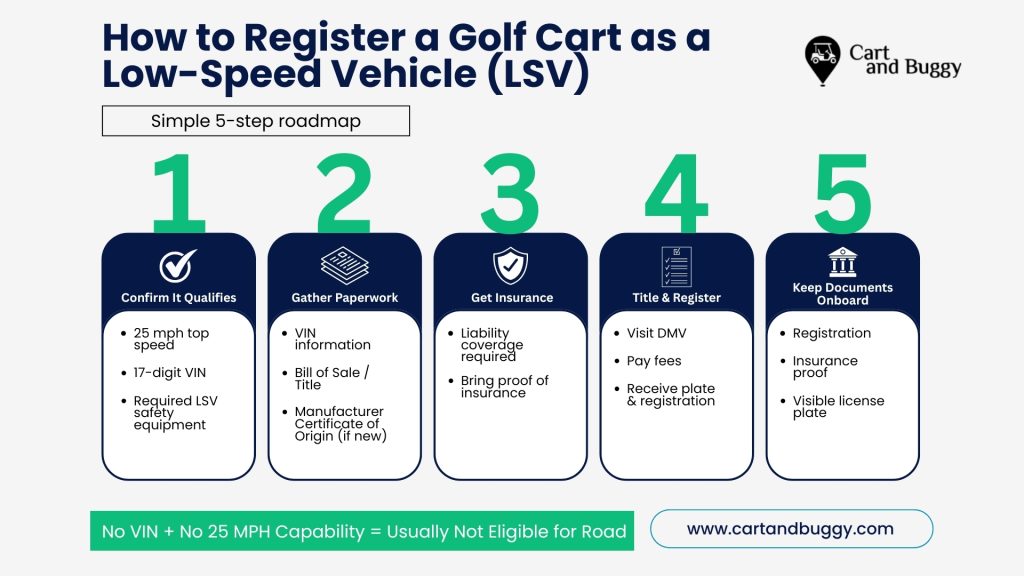
Registration starts with the cart itself, because not every cart can be registered. It must have the low-speed vehicle safety equipment, a 25 mph top speed, and a 17-digit VIN. Carts built as personal vehicles, which top out near 19 mph and lack a full VIN, usually cannot be registered for road use in most states.
If you are buying new, this is easy to confirm. Brands like ICON dealers, Bintelli dealers, and Elite EV dealers sell carts with the VIN already assigned and the equipment in place. If you are looking at an older or used cart, check for the VIN plate and the full equipment list before you count on registering it.
Step two: gather your paperwork
Once the cart qualifies, the paperwork is the next hurdle, and it is usually the slow part. You will typically need the manufacturer’s certificate of origin for a new cart, or a bill of sale and any prior title for a used one, plus the VIN. Some states ask for a safety inspection or a weight slip.
If you bought from a dealer, they often provide the ownership documents and may complete the forms for you. Having everything ready before you go to the motor vehicle office saves a second trip, since a missing document is the most common reason people have to come back.
Step three: get insurance
Most states require insurance before they will register an LSV for the road, so line this up early. LSV policies are widely available and usually inexpensive, because the speeds and the value of the cart are low compared with a car. Coverage typically includes liability at a minimum, with options for collision and theft.
Ask your existing auto or home insurer first, since many add an LSV to an existing policy easily. Keep the proof of insurance with you for the registration appointment, as the office will usually ask for it.
Step four: title, plate, and register
At the motor vehicle office, you title the LSV in your name, pay the registration fee, and receive a license plate. The office records the cart as a low-speed vehicle, which is the legal status that allows it on the road. Fees are modest and vary by state, often similar to registering a small vehicle.
Some states issue a standard plate, others a special LSV plate. Either way, once the plate is on and the registration is in hand, the cart is road-legal within your state’s rules. This step is usually quick if your paperwork is complete.
Step five: what to keep in the cart
After registration, treat the cart like any road vehicle. Keep the registration document and proof of insurance in the cart, since you may be asked for them. Make sure the plate is mounted and visible, and the lights all work. If your state issued a registration sticker, apply it as directed.
This is also a good moment to confirm you understand your local driving rules, including which roads you can use and whether your town has any added restrictions on hours or locations.
Costs, rules, and buying smart
For a cart that already qualifies, registration is usually a same-day errand once your documents are in order. The real-time cost is gathering the paperwork and arranging insurance, not the office visit itself. Costs come in three small pieces: the title and registration fees, which vary by state but are modest, and the insurance premium, which is typically low for an LSV.
A dealer that files the paperwork removes most of this effort, which is one reason many buyers prefer to buy street legal rather than register a cart themselves. The convenience is worth it for most people.
Converting a non-LSV cart is harder
It is tempting to buy a cheaper course cart and try to make it street legal, but this is harder than it sounds. A true LSV must meet the federal safety standard as a whole vehicle, not just wear a few added lights. Many states will not register a cart that was not built and certified as a low-speed vehicle, and some require a manufacturer’s statement that the cart meets the standard.
Adding lights, mirrors, and belts to a course cart does not automatically make it registrable. For most buyers, it is simpler and cheaper in the long run to buy a cart that was built street legal from brands like Tomberlin dealers or Star EV dealers than to try to convert one.
How state rules differ
Registration is a state process, so the details change as you cross state lines. Some states have a straightforward LSV registration with a standard plate and modest fee. Others add a safety inspection, a special plate, or extra restrictions on where the cart can go. A handful are stricter and limit LSV use to certain communities.
Because of this, the smartest move is to check your own state’s motor vehicle website or ask a local dealer who registers carts regularly. They will know the inspection rules, the fees, and the forms for your area, which saves you guessing.
Why buying street legal from a dealer is simpler
The theme throughout all of this is that a dealer makes registration easier. A dealer that sells street-legal carts deals with LSV titling every week. They confirm the cart includes everything your state requires, provide the ownership documents, and often complete the registration so you drive away plated.
When you shop, ask whether the dealer handles the VIN documentation and registration, whether the cart includes your state’s required equipment, and what the all-in cost looks like with plates and fees. Dealers that specialize in road-going models, like Polaris GEM dealers, are used to walking buyers through every step.
A document checklist before you go
Bring more than you think you need so you only make one trip. For a new cart, that means the manufacturer’s certificate of origin, the bill of sale, and the VIN. For a used cart, bring any prior title, the bill of sale, and the VIN. Add your driver’s license, proof of insurance, and payment for the fees. If your state requires a safety inspection or a weight slip, bring that too. A single folder with all of it ready is the surest way to make registration a one-visit errand instead of two.
After you register, and what to avoid
LSV registration is not a one-time event. Like a car, it renews on a schedule set by your state, usually once a year, with a small fee, so keep it current to keep the plate valid. If you move to another state, you will generally need to re-register the cart there, which can mean a new inspection or plate depending on the local rules. And if you sell the cart, transfer the title to the buyer so the registration history stays clean. Treating the LSV like a small vehicle on paper keeps everything simple down the road.
Where dealers fit in the long run
A dealer relationship helps well after registration. The same dealer that sold and registered your cart can handle service, warranty work, and parts, and can advise you if your needs change. Buying from a local dealer who registers carts regularly means you have a knowledgeable contact for renewals, questions, and any issues that come up later. That ongoing support is a big part of why many buyers choose a nearby dealer over a distant or online seller for a street-legal cart.
Registering a used golf cart
A used cart adds a step, because you need to confirm it can be registered before you buy. Check for a 17-digit VIN and the full low-speed vehicle equipment, and ask the seller for any prior title and the certificate of origin. A used cart from a dealer is safer here, since a reputable dealer will not sell a road-going cart it cannot help you register. On a private sale, verify the LSV status yourself first, because a cheap course cart with no VIN can turn into a registration dead end no matter how good the price looked.
License and age requirements
Because a registered LSV is a road vehicle, most states require the driver to hold a valid driver’s license and meet the normal minimum driving age. Some areas set specific rules for who can operate a low-speed vehicle on public roads, and a few allow limited use by younger drivers only on private property. If teens or new drivers will use the cart on the road, check your state’s rules first, since this is one area where local law varies and matters for both legality and insurance.
What happens if you drive an unregistered vehicle
Driving a cart on public roads without proper registration can bring a ticket, fines, and, in some areas, impoundment, and an unregistered cart usually is not covered by insurance if something goes wrong. The shortcut is not worth the risk. If your cart qualifies as an LSV, registering it is inexpensive and quick, and it turns the cart into a vehicle you can drive with confidence. If it does not qualify, keep it on private property until you have one that does.
Common registration problems and how to avoid them
A few issues come up repeatedly. Buying a personal transportation cart by mistake and finding it cannot be registered is the big one, so confirm the LSV class first. Missing paperwork, especially the certificate of origin, sends people back for a second trip, so gather documents in advance. Skipping insurance can stall the registration, so arrange it before your appointment. And assuming a converted course cart will register can lead to a dead end, so buy a factory street legal when road use is the goal.
Avoid these, and registration is usually painless.
Final Thoughts
The easiest path to registration is starting with a vehicle that’s already built for legal road use. Cart & Buggy offers street-legal golf carts designed to meet LSV requirements, helping buyers save time and avoid the challenges that often come with converting a standard golf cart. By starting with a compliant model and following your state’s registration requirements, you can get on the road faster and with greater confidence.