
A new golf cart in 2026 runs from about $8,000 for a simple model to more than $20,000 for a loaded, street-legal lithium cart or a luxury build. Used carts commonly land between $3,000 and $10,000, where the battery condition decides the value more than anything else. Brand and battery type drive most of the difference, with street-legal equipment, seating, and lift adding the rest. This guide breaks down real 2026 price ranges by brand and explains what makes one cart cost thousands more than another.
What moves a golf cart’s price
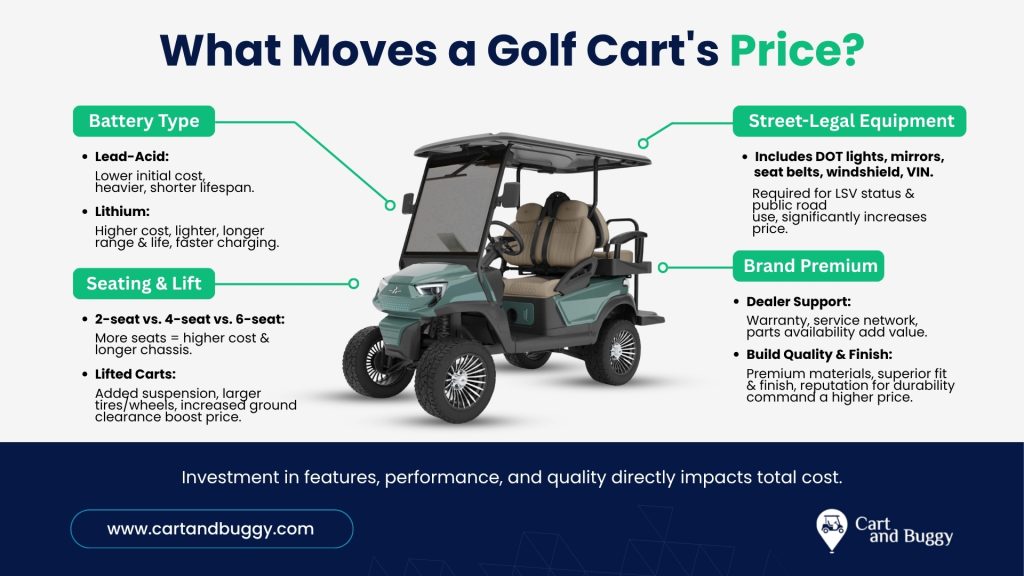
Before the brand names, it helps to know the four levers that move a golf cart’s price. The first is the battery, where lithium adds cost upfront but lasts far longer than lead-acid. The second is street-legal equipment, the lights, mirrors, belts, windshield, and VIN that turn a course cart into a road-legal LSV. The third is seating and lift, since six-seaters and lifted builds cost more than a basic two or four-seater. The fourth is the brand itself, where the big three and luxury names carry a premium for their networks and finish.
Understand those four levers, and most price gaps make sense. A bare four-seat lead-acid course cart and a loaded six-seat lifted lithium LSV are the same idea wearing very different price tags.
How the battery changes the price
The battery is often the single biggest swing in price. A lead-acid cart is cheaper to buy, which is why budget models still use it, but the pack lasts only three to five years, and a replacement set runs roughly $800 to $1,500. A lithium cart costs more upfront, sometimes a few thousand dollars more, but the pack typically lasts eight to ten years or more with little maintenance.
When you compare two versions of the same model, the lithium one almost always carries the higher sticker. Over the life of the cart, though, lithium often costs less because you avoid replacing lead-acid packs. The electric golf carts overview goes deeper into the trade-off.
What street-legal equipment adds
A street-legal cart costs more than a course version of the same model. The added lights, mirrors, seat belts, windshield, horn, and VIN work add several hundred to a couple of thousand dollars, depending on the brand. On many value brands, the street-legal package is folded into the advertised price, so the cart you see is road-ready. On others, it is a separate line item, so always ask whether the quote includes the street-legal setup.
If you only drive on a course or private property, you can skip this cost. If you want to use neighborhood roads, it is money well spent, since it is what makes the cart legal to drive there.
Prices by brand category
Value brands: roughly $8,000 to $16,000
This is where most buyers shop, and the value brands pack in features for the money. ICON dealers price the i40-ECO near $9,999 and core models around $10,000 to $13,000. Evolution dealers price the popular D5 Ranger 4 Plus at around $9,595, with touchscreen trims above it. Star EV dealers start the Capella at around $9,995 and run to about $19,000 for higher trims.
Advanced EV dealers run about $8,300 to $13,900, Bintelli dealers price the loaded Beyond around $11,000 to $16,000, Epic dealers start the E40 near $12,500, and Elite EV dealers generally run $9,000 to $14,000. For most shoppers, the cart that fits comes from this group.
The big three: roughly $9,000 to $24,000
The established names cost a little more, and the money buys a deep service network and strong resale. EZGO dealers price the RXV about $9,000 to $14,000 and the street-legal Liberty around $13,000 to $15,500, with the Express utility line alongside. Club Car dealers start the Onward near $9,475 and run up to about $24,334 for the street-legal CRU, all on the rust-proof aluminum frame that helps resale.
With the big three, part of what you pay for is staying power: parts that stay easy to find and a service department almost everywhere, which matters more the longer you keep the cart.
Specialist and luxury: $15,000 and up
At the higher end, the price reflects design, range, or craftsmanship. Polaris GEM dealers price the two-seat e2 near $15,240, the popular e4 near $17,490, and the six-seat e6 over $21,240, with car-like features and long range. Moke dealers start the retro open-air Moke at around $22,975. Garia dealers sit at the very top of the market, priced well above mainstream brands, with automotive-grade finishes and special editions that climb higher.
These carts are not the value play. They are for buyers who want a specific look, range, or level of finish and will pay for it.
Utility and commercial pricing
Work carts are priced by capability rather than comfort. Cushman dealers, part of the Textron and EZGO family, price gas Haulers from about $7,900, with lithium models into the mid-teens and the Elite Lithium XL near $15,199. These are built for payload and long shifts, not cruising, so the price reflects durability and hauling capacity. The EZGO Express line covers similar ground for buyers who want a work cart from a big-three dealer.
If your need is moving cargo or crews rather than people on a casual ride, this is the category to price against.
Other costs and how to compare
New versus used: where the value is
A new cart brings a warranty, the latest features, and a fresh battery, which is worth the premium for buyers who keep a cart for years. A used cart saves money upfront, with most landing between $3,000 and $10,000, but the battery decides whether it is a deal. A lead-acid pack near the end of its life means an $800 to $1,500 replacement soon, which can erase the savings.
A lightly used lithium cart can be a strong buy, since the pack still has years of life left. On any used cart, ask the age and type of the battery before you talk about price, because it is the number that matters most.
Hidden costs beyond the sticker
The advertised price is rarely the out-the-door price. Freight and setup can add a few hundred dollars, especially if the cart ships from far away. The street-legal package, if not included, is extra. Registration and insurance for a road cart add a modest amount. And accessories like a lift, premium wheels, a sound system, or a rear seat add up quickly if you start checking boxes.
When you compare two dealers or a dealer against an online price, ask for the total out-the-door figure with everything included. That is the only number that lets you compare fairly.
Financing and total cost of ownership
Many dealers offer financing, either in-house or through a lender, with terms that resemble a small vehicle loan. Compare the interest rate and total cost rather than just the monthly payment, since a low payment stretched over a long term can cost more than it looks.
Total cost of ownership goes beyond the purchase. Lithium carts cost more upfront but less over time thanks to battery longevity and low maintenance. A big-three cart may cost more but hold resale value better. Thinking in terms of years of ownership, not just the sticker, often changes which cart is the real value.
How to compare quotes the right way
To compare carts fairly, get an out-the-door price from each dealer that includes freight, setup, the street-legal package if you need it, and any accessories you want. Confirm the battery type and warranty, since a lithium cart at a higher price can be cheaper over time than a lead-acid one. Note the seating and whether a lift is included. Then weigh the local service and reputation of each dealer, because the cheapest quote is not a deal if the support is poor.
Done this way, the comparison is apples to apples, and the right choice usually becomes clear.
Price by seat count
Seating is a clear price ladder. A two-seater is the cheapest layout, a four-seater is the volume seller and the sweet spot for most families, and a six-seater adds a meaningful premium for the extra row. Lifted versions of any of these cost more than their standard counterparts because of the larger wheels, longer suspension, and added parts. If budget is tight, a standard four-seater gives the most cart for the money, while a six-seat lifted build sits at the higher end of a brand’s range. Decide how many people you actually carry on a normal trip before you pay for seats you rarely use.
What accessories add to the price
The base cart is only the starting point. A lift kit, premium wheels and tires, an upgraded sound system, a rear flip seat, a windshield, a cooler, and custom paint or seats all add to the total, and it is easy to add a few thousand dollars in extras without noticing. Some of these, like a rear seat or a windshield, are genuinely useful. Others are purely cosmetic. When you build a cart with a dealer, ask for the price of each option separately so you can see where the money goes and skip the extras you will not use.
Gas versus electric, and the price
Powertrain affects price, too. Electric carts dominate the personal market and span the full price range, while gas models, offered mainly by the big three and utility brands, can carry a different price depending on the engine and features. Electric carts cost only pennies to charge and need less maintenance, while gas costs more per mile but refuels in minutes for long days. For most buyers, the choice is electric, but if you need all-day range far from an outlet, a gas model from EZGO dealers or Club Car dealers is worth pricing.
Where prices are headed
Golf cart prices have held fairly steady into 2026, with value brands keeping entry-level lithium carts near the $10,000 mark and the big three holding their premium. Tariffs and supply costs can nudge import-brand pricing, so a quote that is good this month may shift later. The practical move is to get current out-the-door numbers from a few dealers rather than relying on last year’s figures, and to buy when a dealer has the configuration you want in stock rather than waiting on a long special order.
Final Thoughts
Golf cart prices vary widely based on the battery, seating capacity, street-legal equipment, and brand you choose. While budget-friendly models can start around $8,000, premium lithium-powered, road-ready carts can easily exceed $20,000. The best value comes from matching the cart to how you’ll actually use it rather than simply choosing the lowest price. Whether you’re comparing brands, exploring lithium upgrades, or shopping for a street-legal model, Cart & Buggy can help you understand your options and find a cart that fits both your needs and your budget. With the right combination of features, warranty coverage, and local support, you’ll enjoy better value long after the purchase is complete.