
For most new buyers, lithium is the better golf cart battery because it lasts longer, charges faster, weighs less, and needs almost no maintenance, while lead-acid wins mainly on a lower upfront price. Lithium typically lasts eight to ten years or more, while lead-acid lasts about three to five. The right choice comes down to your budget and how much you drive. This guide compares the two on every measure that matters so you can decide with confidence.
Lithium vs lead-acid: the basics
The short answer
If you plan to keep your cart for years and drive it regularly, lithium is usually the smarter buy, because its longer life and low upkeep make it cheaper over time despite the higher sticker. If you want the lowest possible price, drive only occasionally, or plan to keep the cart for a short time, lead-acid can still make sense. Both will get you around. The difference is in cost over time, convenience, and performance.
Upfront cost
Lead-acid wins on the day you buy. A lead-acid cart is cheaper than the same model with lithium, sometimes by a few thousand dollars, which is why budget carts and many used carts still use it. For a buyer focused on the lowest entry price, lead-acid is the obvious pick.
Lithium costs more upfront because the pack and its management electronics are more expensive to build. That premium is the main reason some shoppers hesitate. The question is whether the lower running cost over the years makes up for it, and for most regular users, it does.
Lifetime cost
This is where lithium turns the tables. A lithium pack typically outlives two or three sets of lead-acid batteries. Each lead-acid replacement runs roughly $800 to $1,500, so over a decade, the cheaper battery can end up costing as much as or more than lithium once you count replacements.
Add the time and hassle of swapping packs, and the math often favors lithium for anyone keeping a cart long term. If you only keep a cart for a couple of years, lead-acid may still come out ahead, since you never reach the first replacement.
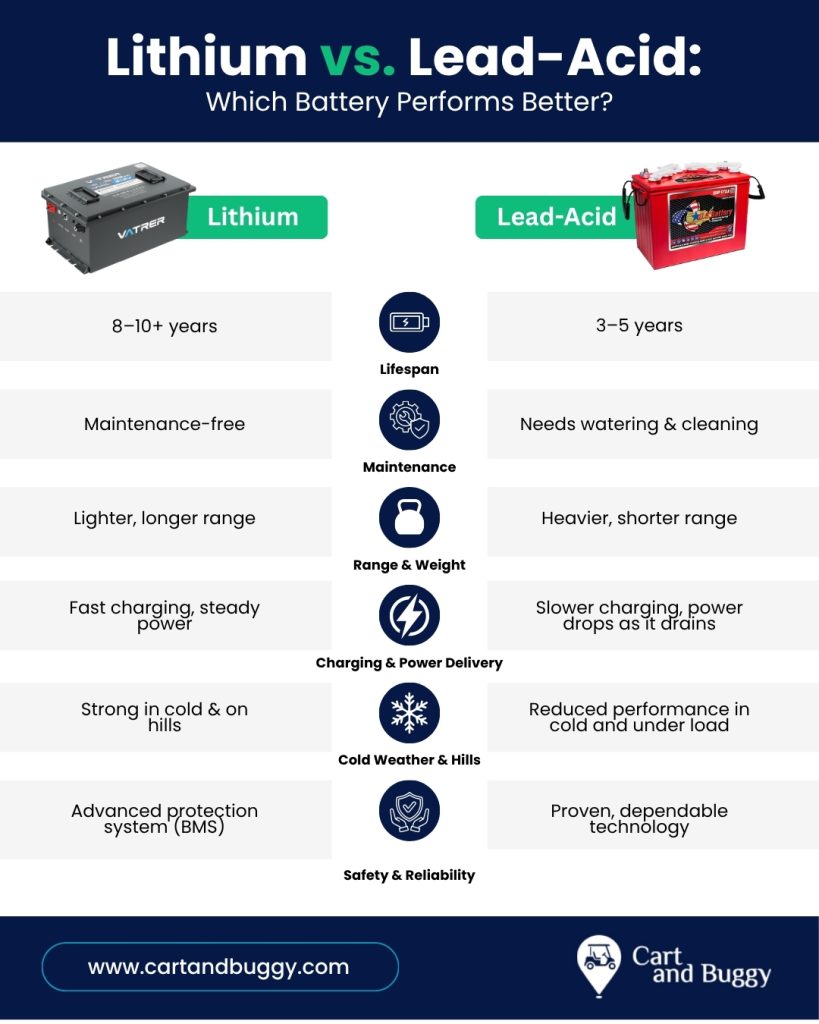
How they compare on performance and care
Lifespan
Lead-acid batteries last about three to five years with regular care, and less if they are neglected. They wear out gradually, losing range and power as they age. Lithium batteries commonly last eight to ten years or more, holding their capacity well through most of that life before tapering off.
The gap is large enough that it changes how you think about the cart. A lithium cart bought today may never need a battery during your ownership, while a lead-acid cart almost certainly will.
Maintenance
Lead-acid takes work. The batteries need their water levels checked and topped off on a schedule, the terminals kept clean of corrosion, and the pack kept charged so it does not sulfate and lose capacity. Skip this care, and the batteries die early.
Lithium is essentially maintenance-free. There is no water to add, no regular upkeep, and the battery management system handles charging and balancing. For buyers who want to plug in and forget it, this is one of lithium’s strongest advantages.
Range and weight
Lithium is much lighter than lead-acid, often by hundreds of pounds across a full pack. That lower weight improves range, acceleration, and handling, and it is easier on tires and suspension. A lithium cart generally goes farther on a charge than the same model on lead-acid.
Lead-acid is heavy, which drags down range and makes the cart feel less nimble. The weight is not all bad, since it can add a planted feel, but for range and efficiency, lithium has the clear edge.
Charging speed and behavior
Lithium charges faster and wastes less energy as heat, so it is ready to go sooner and costs slightly less to charge. It also delivers consistent power as it drains, so the cart feels just as strong near the end of a charge as at the start.
Lead-acid batteries charge more slowly and sag toward the end of a charge, so the cart slows and weakens as the batteries deplete. If you make several trips a day or want a quick turnaround, lithium’s faster charging is a real convenience.
Cold weather and power delivery
Lithium handles cold better than lead-acid, holding more of its capacity when temperatures drop, though very low temperatures slow any battery, and charging indoors helps. Its steady power delivery also means hills and full loads do not sap performance the way they can with a tired lead-acid pack.
Lead-acid loses noticeable capacity in the cold and weakens under heavy load as it ages. For buyers in cold climates or hilly areas, lithium’s behavior is easier to live with year-round.
Safety and reliability
Both battery types are safe when built and used properly. Quality lithium packs include a battery management system that protects against overcharging, overheating, and imbalance, which adds a layer of reliability. The key is buying a cart with a reputable lithium pack and a real warranty, since quality varies among the cheapest imports.
Lead-acid is a mature, well-understood technology with no electronics to fail, which some buyers like for its simplicity. Neither is a safety concern in a properly maintained cart.
Choosing the right battery
If you are shopping used, do not assume. Lithium packs are lighter, fit in a smaller case, and the cart often shows “lithium” on the dash or in its badging. Lead-acid carts have several heavy batteries under the seat, each with caps for adding water. Lift the seat and look.
Ask the seller or dealer directly, and on a lithium cart, ask about the brand and warranty of the pack, since quality matters. The battery is the single biggest factor in what a used cart is worth, so confirm it before you talk price.
Which brands use which
Most premium and modern carts now ship with lithium. ICON dealers, Evolution dealers, Star EV dealers, and Bintelli dealers build lithium into their core models. EZGO dealers offer the ELiTE lithium option on upper trims, and Club Car dealers offer lithium across the Onward line.
Many value brands also offer a lead-acid base model with a lithium upgrade, so you can choose based on budget. Ask the dealer which cart in front of you uses, since the same model can come either way.
When lead-acid still makes sense
Lead-acid is a fair pick in a few cases: when the lowest upfront price is the priority, when the cart sees only light or occasional use, or when you plan to keep it just a short time. It is also common on used carts and budget models, where it keeps the entry price low.
If any of those describe you, lead-acid is not a mistake. Just go in knowing the pack will need replacing in a few years and budget the $800 to $1,500 for it.
Can you upgrade a cart to lithium?
Yes, in many cases, you can convert a lead-acid cart to lithium later, and some owners do it when the original pack wears out. A conversion involves a compatible lithium pack and sometimes a charger or wiring change, so it is worth having a dealer or technician confirm fit and cost. For some owners, upgrading at replacement time is a way to get lithium’s benefits without paying for it upfront. Ask a dealer whether your model supports a clean lithium conversion.
Warranty differences to weigh
Battery warranties differ sharply between the two types, and the warranty is part of the value. Lithium packs commonly carry warranties in the range of five to eight years, reflecting their long expected life, while lead-acid warranties are shorter. Read what the warranty actually covers, including whether it is prorated and whether it is honored through the dealer network. A strong lithium warranty adds peace of mind that helps justify the higher upfront price, since it protects the most expensive component in the cart for years.
How battery type affects resale
The battery also shapes what your cart is worth later. A cart with a healthy lithium pack holds value better, because the next buyer knows the most expensive part has years of life left. A cart with aging lead-acid batteries is worth less, since the new owner faces a replacement soon. If you think you might sell or trade the cart in a few years, lithium not only saves you maintenance but also protects resale value, which is worth factoring into the upfront decision.
Mixing battery types is not an option
One thing to avoid: you cannot mix lithium and lead-acid in the same pack, and you should not pair old and new lead-acid batteries either, since the weakest battery drags down the whole set. When a lead-acid pack wears out, replace the full set at once. When upgrading to lithium, the entire pack and often the charger change together. Knowing this prevents a common and costly mistake, and a dealer can confirm the right path for your cart.
A simple way to decide
If you are stuck, a quick rule helps. Choose lithium if you will keep the cart more than a few years, drive it regularly, want low maintenance, or care about resale. Choose lead-acid if the lowest upfront price is the priority, the cart will see light or occasional use, or you plan to keep it only a short time. Most buyers who plan to enjoy a cart for years land on lithium, while budget-focused or light users are well served by lead-acid. Either way, confirm with the dealer which battery the specific cart uses, and ask to see the pack and its warranty in writing before you commit, since the battery is the heart of an electric cart.
Two real-world examples
Consider two buyers. One drives a cart daily around a large neighborhood and has kept vehicles for a decade. For them, lithium pays off through years of use with no battery swaps and stronger resale when they finally sell. The other uses a cart a few weekends a year at a cabin and plans to sell in two years. For them, lead-acid keeps the entry price low, and they never reach a replacement. Same question, different answers, because use and time horizon decide the value, not the technology alone. Match the battery to how you will actually live with the cart, and the choice usually makes itself.
Final Thoughts
The best golf cart battery is the one that fits the way you use your cart. Lithium offers longer life, faster charging, and minimal maintenance, while lead-acid remains a cost-effective option for occasional drivers and budget-conscious buyers. At Cart & Buggy, we recommend looking beyond the upfront price and considering factors such as lifespan, replacement costs, and long-term value. With the right battery and proper care, you can maximize performance, extend battery life, and get the most value from your golf cart for years to come.