
A golf cart battery lasts about three to five years if it is lead-acid and eight to ten years or more if it is lithium, assuming normal use and reasonable care. The exact lifespan depends on the battery type, how often and how deeply you discharge it, your charging habits, and your climate. Knowing what shortens battery life and how to spot a failing pack helps you replace it before it strands you. This guide covers lifespan, costs, warning signs, and the habits that add years.
Lifespan, warning signs, and cost
Battery type is the biggest factor in how long a pack lasts. Lead-acid batteries, the traditional and cheaper option, typically last three to five years, and they need regular care to reach the high end of that range. Lithium batteries last far longer, often a decade or more, with little upkeep, which is a major reason new premium carts have moved to lithium.
If you are buying and want the longest life with the least effort, lithium is the answer. If you are working with a lead-acid cart, good habits are what push the pack toward five years rather than three.
What shortens battery life
Several habits wear batteries out faster than they should. Letting a lead-acid pack sit discharged is one of the worst, since it lets the plates sulfate and lose capacity. Skipping the water checks on lead-acid batteries does similar damage. Charging in extreme heat stresses any battery, and deep-draining the pack to near empty every trip shortens its life.
Storing a cart over winter without maintaining the charge is a common way to kill a pack early. Most of these are avoidable with simple habits, which is why two identical carts can have very different battery lifespans based on how they are treated.
Warning signs that a battery is failing
Batteries usually warn you before they quit. Watch for a clear drop in range, where the cart no longer goes as far on a full charge as it used to. Notice if acceleration feels weaker or the cart struggles on hills it used to climb easily. Longer charging times and a pack that will not hold a full charge overnight are also signs.
On lead-acid, look for swollen battery cases, corrosion at the terminals, or a rotten-egg smell, which point to a pack near the end. When the range falls off sharply, the battery is usually close to needing replacement.
What replacement costs
Replacement cost depends on the battery type. A lead-acid replacement set runs roughly $800 to $1,500, depending on the cart and the batteries, and since lead-acid lasts only a few years, most owners face this cost more than once. Lithium replacements cost more per pack but are needed far less often, sometimes never during a typical ownership.
This is why battery condition is the most important factor when pricing a used cart from any brand, from EZGO dealers to ICON dealers. A low price on a cart with a dying lead-acid pack is not the deal it looks like.
How to make your battery last longer
A few habits add real years to a pack. Charge after each use rather than draining the battery flat, since deep discharges wear batteries faster than partial ones. For lead-acid, check the water level on a regular schedule and keep the terminals clean and tight. Avoid charging in extreme heat when you can, and do not leave the cart sitting at a low charge for long periods.
These steps are simple and cheap, and they often mean the difference between a lead-acid pack that dies at three years and one that lasts five. For lithium, the maintenance is minimal, but sensible charging still helps.
Charging habits that help
Good charging habits protect any battery. Use the charger that came with the cart or one that the maker recommends, since modern chargers manage the charge cycle safely. Charge after use so the pack is not left depleted, and let the charger complete its cycle rather than unplugging early on lead-acid.
Avoid charging in very hot or very cold spaces when possible, and make sure the connections are clean so the charge flows properly. With lithium, the battery management system handles most of this, but a steady charging routine still extends life.
Storage and winter care
Storing a cart for the off-season is where many batteries die. For lead-acid, the pack should be fully charged before storage and topped up periodically, since a discharged lead-acid battery sitting all winter can be ruined by spring. Keep the cart somewhere that avoids extreme heat, and disconnect or maintain the battery as the maker advises.
Lithium tolerates storage better, but it should still be stored at a reasonable charge level rather than full or empty, and at a moderate temperature. A little attention before storage saves a costly replacement later.
Checking a used cart’s battery
When buying used, the battery is the first thing to investigate. Ask for the age and type of the pack, and on lithium, the brand and remaining warranty. Lift the seat to see whether it is lead-acid with water caps or a lighter lithium pack. If you can, take a test drive that includes a hill, and watch for weak acceleration or a fast-dropping charge gauge.
A cart from a dealer that inspects and stands behind its used inventory is safer than a private sale, where a tired battery becomes your problem the week after you buy. For more on comparing the two chemistries, see the electric golf carts overview.
Lead-acid versus lithium longevity
The longevity gap is the clearest reason buyers move to lithium. A lead-acid pack at three to five years means you will likely replace it during ownership, while a lithium pack at eight to ten years or more may outlast your time with the cart. Lithium also ages more gracefully, holding capacity well before tapering, while lead-acid fades more steadily from the start.
If long life with little effort is the goal, lithium delivers it. If the lowest upfront price is the goal, lead-acid does the job for a few years at a time.
When to repair versus replace
Sometimes a single weak lead-acid battery in a pack can be the problem, but replacing just one is usually a short-term fix, since the others are the same age and will follow soon. Most technicians recommend replacing the full lead-acid set at once so the batteries age together. For lithium, the pack and its electronics are generally replaced as a unit rather than repaired.
If a charger or connection is the real issue, that is a cheaper fix than the battery, so have a dealer or technician diagnose the cause before you assume the pack is dead. A quick diagnosis can save you the cost of a replacement you did not need.
How climate affects battery life
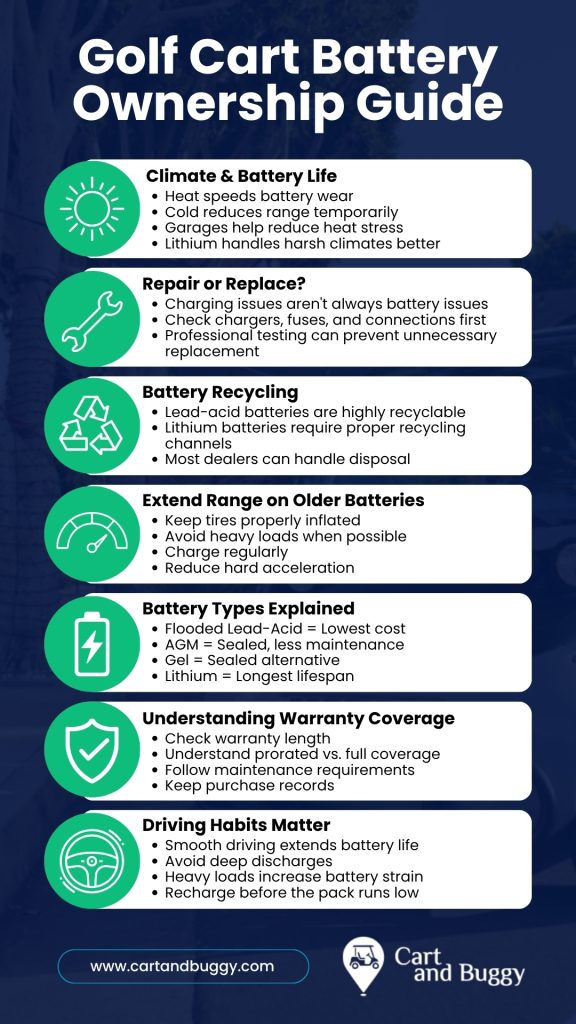
Where you live shapes how long a battery lasts. Extreme heat is hard on batteries, speeding up wear and water loss in lead-acid packs, while extreme cold temporarily cuts range and slows charging. Hot, humid climates tend to shorten lead-acid life, which is one reason owners in those areas often prefer lithium. If you store or charge the cart in a garage rather than in the open sun, you reduce the heat stress. Climate will not override good habits, but it does set the baseline for what to expect from a pack.
Fixes versus full replacement
Not every battery problem means a new pack. A cart that suddenly will not charge may have a bad charger, a blown fuse, a loose connection, or corroded terminals, all cheaper to fix than the battery. A single dead cell in a lead-acid set can sometimes be traced, though replacing the whole set is the lasting fix. Before you spend on batteries, have a dealer or technician test the pack and the charger so you are not replacing a healthy battery to solve a wiring problem.
Disposal and recycling
When a pack finally dies, dispose of it responsibly. Lead-acid batteries are highly recyclable, and most dealers and auto parts stores will take them, often for a small core credit. Lithium packs should also be recycled through proper channels rather than thrown away, and a dealer can usually handle this when they install the replacement. Letting the dealer manage the old pack at replacement time is the easiest route and keeps the batteries out of the trash.
Getting more range from an aging pack
As a battery ages, a few habits stretch the range you have left. Keep the tires properly inflated, since low pressure wastes energy. Avoid heavy loads and steep hills when you can, ease off hard acceleration, and keep the pack charged rather than running it near empty. None of this reverses the wear, but it helps you get the most from the battery until you are ready to replace it, and it applies to a fresh pack too.
Battery types beyond the basics
Most carts use either flooded lead-acid or lithium, but you may also see AGM and gel lead-acid variants. AGM batteries are sealed, need no watering, and tolerate vibration better, but cost more than flooded lead-acid and still fall short of lithium on lifespan. Gel batteries are another sealed option with similar trade-offs. When a dealer quotes a cart, ask exactly which battery type it uses, since the term lead-acid can mean flooded, AGM, or gel, and the maintenance and price differ across them.
What a battery warranty covers
A battery warranty is only useful if you understand it. Check the length, whether it is full or prorated, and what voids it, since neglect, like running a lead-acid pack dry, can cancel coverage. Confirm the claim is honored through a local dealer rather than only the factory, so a failure does not mean shipping a heavy pack across the country. On lithium, the warranty often runs five to eight years, which is a strong sign of the pack’s expected life. Keep your proof of purchase and any maintenance records in case you need to claim.
How driving style affects battery life
How you drive matters as much as how you charge. Hard acceleration, constant hill climbing, and running the pack to near empty every trip all shorten battery life, while smooth driving and partial discharges are gentler on the cells. Carrying heavy loads regularly draws more from the pack, too. None of this means babying the cart, but easygoing use and recharging before the pack runs low add up to a longer-lasting battery over the years.
Final Thoughts
Golf cart batteries are one of the most important factors in the long-term cost of ownership. Whether you’re driving an EZGO, ICON, Club Car, Bintelli, or another electric cart, understanding battery lifespan, replacement costs, and proper maintenance can save you money and prevent unexpected downtime. At Cart & Buggy, we recommend paying close attention to battery type when shopping for a new or used cart, since a healthy battery pack can be worth thousands of dollars over the life of the vehicle. With the right care and charging habits, you can maximize battery performance, extend its lifespan, and get more value from every mile you drive.