
ICON, Evolution, and Star EV are three of the strongest value golf cart brands, and they overlap heavily on price while differing in personality. ICON is the recognized value leader with the widest lineup, Evolution leans hardest into touchscreen technology, and Star EV pairs a genuinely quiet drive with a factory street-legal flagship. All three sell loaded lithium carts for less than the big three, which is why they so often end up on the same shortlist. This guide compares them on price, features, street-legal options, ride, and the honest trade-offs so you can pick the one that fits.
How the three compare at a glance
| Brand | Entry price | Stands out for | Watch for |
|---|---|---|---|
| ICON | about $9,999 | Widest lineup and proven value | Resale versus the big three |
| Evolution | about $9,595 | Touchscreen and car-style tech | Parts outside strong dealer areas |
| Star EV | about $9,995 | Quiet drive and factory LSV | Regional parts familiarity |
The table sets the scene, but the right choice depends on what you value, so here is the detail behind each brand.
ICON: the value leader
ICON has become the name most people picture when they think of a value street-legal cart. The lineup is broad, running from the entry i40-ECO near $9,999 to core i40 and i60 models around $10,000 to $13,000, plus a premium ICON X line. Most ships with a display, a backup camera, four-wheel disc brakes, and full street-legal equipment, which makes them feel loaded for the price.
The brand’s other strength is availability. The dealer network keeps growing, which helps with both buying and service, and the long model list means there is usually a configuration that fits. Many ICON dealers also carry the Epic line, so you can compare siblings in one visit. For buyers who want a proven, widely available choice, ICON is the safe pick.
Evolution: the technology pick
Evolution, owned by HDK, grew quickly by putting car-style tech into mid-priced carts. The popular D5 Ranger 4 Plus sits near $9,595, with premium D-Max and XT trims above it, and the range stretches to about $15,000. The headline features are a 9 to 10-inch touchscreen, Apple CarPlay and Android Auto, a backup camera, and premium audio on higher trims.
That technology is the reason buyers choose Evolution over its rivals. If you want the cart that feels most like a modern car inside, Evolution dealers deliver it for the money. The trade-off is the usual value-brand caution about resale and parts depth, which makes a strong local dealer important.
Star EV: the quiet value LSV
Star EV is a South Carolina brand that has climbed into genuine contention. The Capella value line starts around $9,995, and the street-legal Sirius starts near $14,400, with the range reaching about $19,000. The brand’s signatures are a genuinely quiet drive system and the Sirius, which is engineered to meet federal motor vehicle safety standards from the factory rather than needing aftermarket parts to be road-legal.
That factory street-legal engineering is a real selling point, since it saves the time and cost of making a cart road-ready. For buyers who want a quiet ride and a plate-ready LSV, Star EV dealers are worth a close look, especially where a capable Star dealer is nearby.
All three, if you can, before deciding.
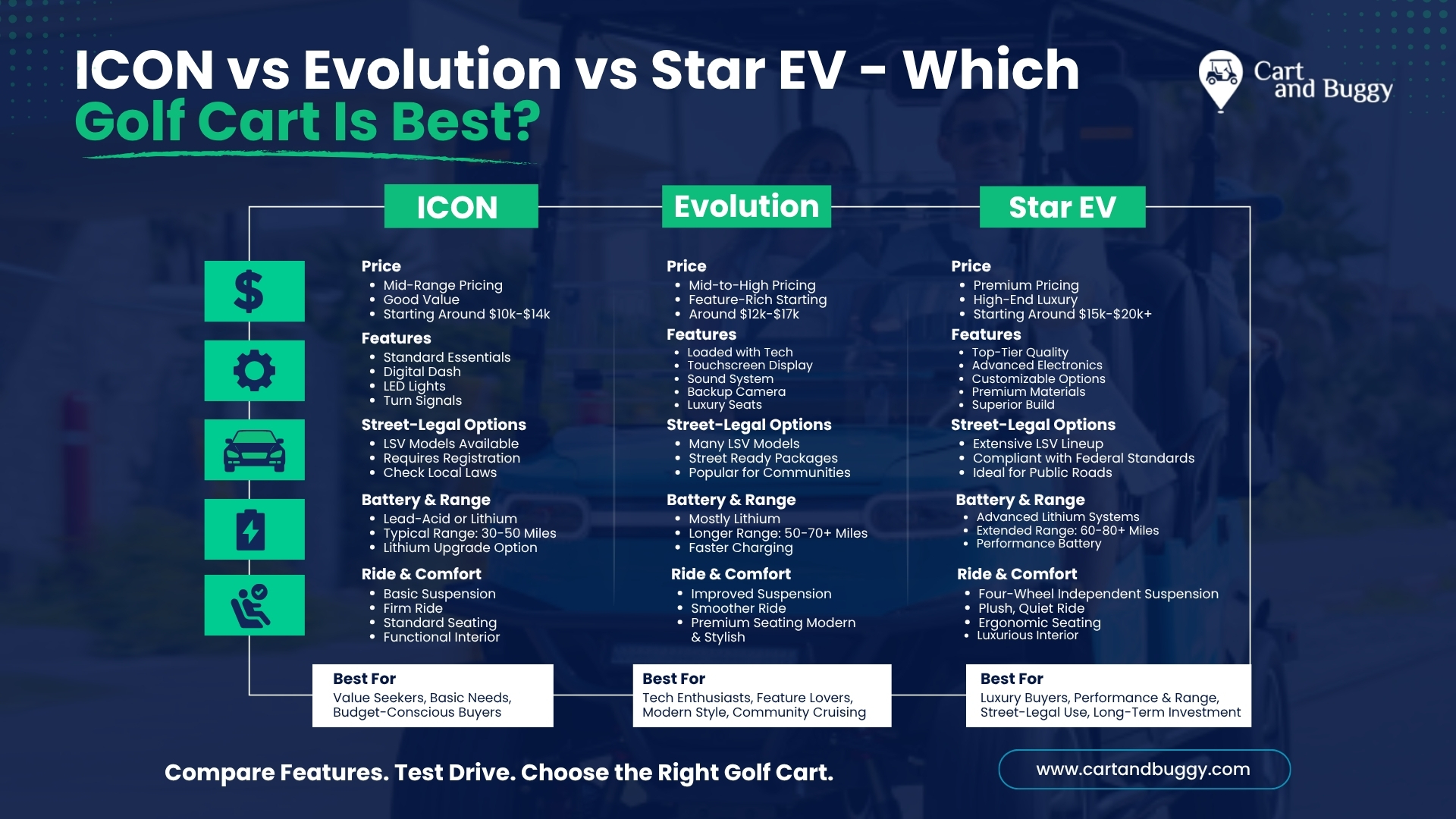
Price compared
On price, the three are remarkably close at the entry point, all clustering around $9,500 to $10,000 for a four-seat lithium cart. The gaps open up as you climb the trims. ICON’s premium ICON X line and Evolution’s D-Max push higher, while Star EV’s Sirius commands more for its factory street-legal build. For a like-for-like four-seater, expect the prices to land within a few hundred dollars of each other, which means features and dealer support often decide the choice rather than price alone.
Features and standard equipment
All three pack in features, but with different emphasis. ICON spreads a strong standard kit across a wide lineup. Evolution concentrates on the screen and infotainment experience. Star EV balances comfort and quiet with solid equipment. When you compare specific trims, look at what is standard versus optional, since a slightly cheaper cart can cost more once you add the display, camera, or sound system that another brand includes. Ask each dealer for the standard feature list on the exact trim you are pricing.
Street-legal options compared
If road use is the goal, all three offer it, but the approach differs. Star EV’s Sirius is engineered street legal from the factory. ICON ships most models as low-speed vehicles with the lights, mirrors, belts, and VIN included. Evolution offers street-legal lighting packages across its lineup. In every case, confirm the specific cart is the 25 mph LSV version with a VIN, not a slower personal transportation model, and that the dealer will handle registration.
Battery and range
All three build lithium into their core models, which is a big part of their value story. Lithium gives them longer life, faster charging, and stronger range than older lead-acid carts, typically covering enough distance for neighborhood and community use on a charge. Some offer a lead-acid base option to lower the entry price, with lithium as the upgrade. Confirm which the cart uses, since the same model can come either way, and lithium is the one that holds value and lasts.
Ride and comfort
Ride quality is where personalities show. Star EV’s quiet drive system gives it a calm, refined feel that owners notice. Evolution’s modern interior and screen make it feel current. ICON’s broad lineup means you can find a comfort level to match your budget, from basic to premium. A test drive is the only way to judge which seats, suspension, and noise level suit you, so drive
Trade-offs and how to choose
All three are value brands, so the same cautions apply. Resale value and the depth of the parts network trail the big three, and the steel frames need rust care near saltwater. None of these are dealbreakers, but they are real. The fix for each is the same: a capable local dealer who stocks parts and stands behind the cart. If the deepest service network matters more than the value, compare these three against EZGO dealers and Club Car dealers first.
Why does dealer support decide it?
Because the three carts are so close on price and features, the dealer often matters more than the brand. A strong local dealer for any of them means easy service, available parts, and help with warranty and registration. A weak or distant dealer turns a small repair into a hassle. Before you choose, find out which of the three has the most capable, established dealer near you, since that support will shape your ownership more than the small differences between the carts.
How to decide by use case
Pick ICON if you want the proven, widely available choice with the broadest lineup. Pick Evolution if the touchscreen, phone integration, and modern feel matter most to you. Pick Star EV if you want a quiet ride and a factory street-legal cart without big-three pricing. In all three cases, let the local dealer be the tiebreaker, because the brand that has a strong shop near you is the one that will be easiest to live with for years.
How do they compare on warranty?
Warranty coverage is worth comparing, since it protects the priciest parts. All three back their lithium packs with multi-year coverage, often in the five- to eight-year range, and add separate vehicle warranties on the frame and components. The length and terms vary by brand and trim, and the practical question is whether the warranty is honored through a local dealer. A strong warranty serviced nearby is worth more than a longer one that means shipping parts. Ask each dealer for the written warranty on the exact cart, including what voids it and how claims are handled.
Resale value over time
Resale is one area where these value brands trail the big three, and it is worth weighing if you may sell in a few years. A well-kept lithium cart from any of the three holds value better than a lead-acid one, and ICON’s wide recognition can help it sell. Evolution and Star EV resell fine in regions where their dealers are established. None match Club Car’s resale strength, but the lower purchase price offsets some of that gap. If resale is a priority, lean toward a recognized model with a lithium pack and keep your service records.
Accessories and customization
All three brands support a range of accessories, from lifts and premium wheels to sound systems, rear seats, and custom colors. ICON and Epic share a deep accessory catalog through their common platform. Evolution leans into its screen and audio ecosystem. Star EV offers comfort and storage upgrades. Decide which extras you actually want before you shop, since accessories add up quickly, and ask the dealer to price them separately so you can see the real cost of a built-up cart versus a base model.
Which brand fits which buyer
To sum it up, ICON fits the buyer who wants the proven, widely available choice with the broadest lineup and easy access to parts. Evolution fits the buyer who wants the most car-like tech and screen for the money. Star EV fits the buyer who wants a quiet ride and a factory street-legal cart at a value price. Across all three, the smart move is the same: find which brand has the strongest local dealer, because that relationship outlasts the small differences between the carts.
A note on the big-three alternative
If you find yourself torn among these three and also wondering about the big three, here is the quick frame. ICON, Evolution, and Star EV give you more features and a lower price, while EZGO and Club Car give you a deeper service network, stronger resale, and, on Club Car, a rust-proof aluminum frame. If you plan to keep the cart a long time, value the widest service coverage, or live near saltwater, it is worth pricing a big-three cart alongside these three before you decide. For most buyers focused on value and features, though, these three deliver more carts for the money, and the choice among them comes down to lineup, tech, or quiet ride, plus the dealer near you.
Final Thoughts
When comparing ICON, Evolution, and Star EV, there is no single winner for every buyer. The best choice depends on what matters most to you: proven value and availability, cutting-edge technology, or a quiet, factory street-legal ride. Because pricing is often very similar, dealer support, warranty coverage, and long-term service should carry as much weight as the features list. At Cart and Buggy, we recommend test-driving your top contenders, comparing local dealer support, and focusing on the ownership experience as much as the purchase price. In the end, the right golf cart is the one that delivers the features you need today and the reliability and support you’ll appreciate for years to come