
A street-legal golf cart is a low-speed vehicle, or LSV, that meets a set of federal and state equipment rules and can be driven on most roads posted at 35 mph or less. To qualify, it needs specific safety equipment, a top speed in the 20 to 25 mph range, and in most states, a 17-digit VIN so it can be titled, plated, and insured. A regular golf cart without that equipment is built for a course or private property, not public roads. The difference matters because driving the wrong kind of cart on the road can mean a ticket, a voided insurance claim, or worse.
This guide explains what makes a cart street legal, how fast it can go, the terms you will hear, where you can and cannot drive, and how dealers handle the setup and paperwork.
What makes a golf cart street legal
What street legal actually means
Street legal is not a marketing phrase. It is a legal category. The federal government created the low-speed vehicle class so small electric vehicles could share public roads safely at low speeds. A cart that meets the low-speed vehicle standard, equips the required safety gear, and stays at or below 25 mph can be registered like a small vehicle and driven on roads within the speed cap.
The key idea is that the cart is built and certified for the road from the factory, not modified into something that looks road-ready. When a brand advertises a street-legal model, it means the cart leaves the line with the equipment, the speed rating, and the VIN that registration requires. That is very different from adding a set of lights to a course cart and hoping it passes.
The equipment a street-legal cart needs
Low-speed vehicle rules call for a specific equipment list, and a factory street-legal cart ships with all of it. The core items are headlights, tail lights, brake lights, turn signals, and reflectors so the cart is visible and signals its moves. It needs a windshield, rear-view mirrors, and a horn for awareness, plus a parking brake. Seat belts are required for every seat, and the cart must wear a 17-digit VIN that identifies it as a low-speed vehicle.
Most factory carts add DOT-rated tires and a windshield wiper as well. When you shop, the simple test is whether the cart already has every one of these items as standard. If a seller is offering to add them later, you are not looking at a true factory LSV, and registration may be harder.
How fast does a street-legal cart go
By federal definition, a low-speed vehicle tops out at 25 mph. That cap is not a limitation the maker chose at random. It is the exact ceiling that allows the cart on roads posted at 35 mph or less in most states. Go faster than 25 mph, and the cart leaves the low-speed category, which can make it illegal to drive on those same roads and can void the warranty and insurance.
There is a slower class to know about, too. Some carts are sold as personal vehicles that top out closer to 19 mph. A personal vehicle is not the same as an LSV and may not be road-legal where you live. If road use is the goal, confirm the cart is the 25 mph LSV version, not the slower personal model that shares the same body.
LSV, NEV, PTV, and golf cart: the terms explained
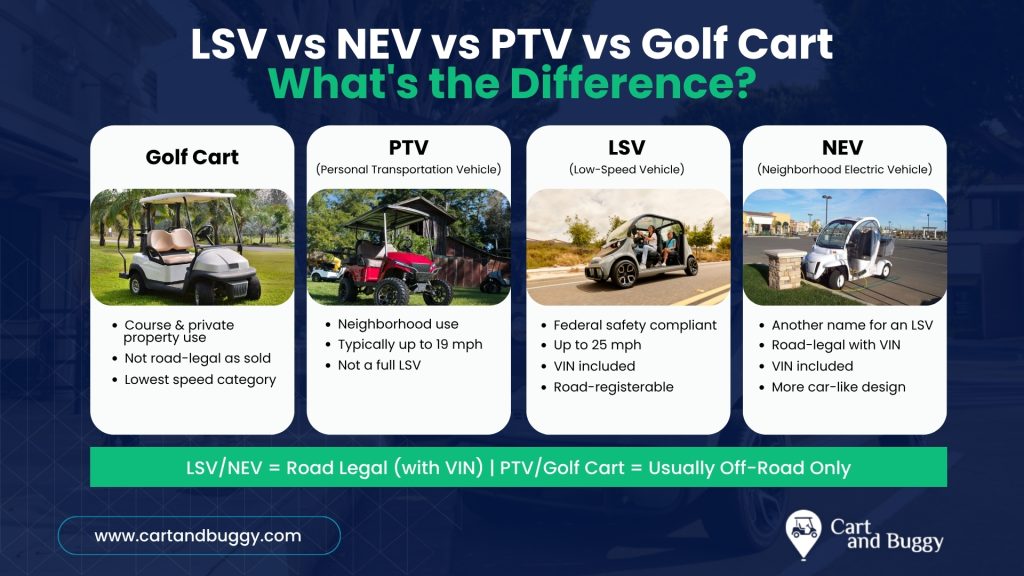
The category names get used loosely, so here is the plain version. A golf cart is built for a course or private property and is not road-legal as sold. A personal vehicle, or PTV, is a neighborhood cart that usually tops out near 19 mph and is not a full LSV. A low-speed vehicle, or LSV, meets the federal safety standard, hits 25 mph, and carries a VIN, so it can be registered for the road. A neighborhood electric vehicle, or NEV, is another name for an LSV, often used for vehicles that feel closer to a small car, like the models from Polaris GEM dealers.
Knowing which term a seller uses tells you what you are buying. If the listing says LSV or NEV with a VIN, it is built for the road. If it says PTV or golf cart, plan to keep it off public streets unless your area allows the slower class.
Where you can and cannot drive
Federal rules set the equipment and the 25 mph cap, but where you can actually drive is decided by your state and your town. Most states that allow LSVs permit them on roads posted at 35 mph or less. Beyond that, the details are local. Some towns let you cross a higher-speed road at an intersection without driving along it, others publish a map of approved streets, and a few require a local permit or limit the hours you can drive.
A few rules are nearly universal. LSVs are not allowed on highways or interstates, and they do not belong on sidewalks or bike paths. Before you rely on a cart for daily errands, look up your town’s ordinance or ask a local dealer, since the dealers that sell street-legal carts usually know the rules for the areas they serve.
Do you need a license, insurance, and registration?
In most places, driving a registered LSV on the road requires a valid driver’s license, the same as a car, because you are operating a vehicle in traffic. Registration is required to plate the cart, and most states also require insurance once it is road-registered. LSV insurance is usually inexpensive compared with a car policy, since the speeds and values are lower.
The exact requirements vary by state, so treat this as the general rule. The practical point is that a street-legal cart is a real vehicle in the eyes of the law, which is part of why buying one from a dealer who handles registration saves a lot of hassle.
Buying and owning a street-legal cart
Brands built for street use: Several brands make street-legal models a standard part of the lineup rather than an afterthought.
Street-legal specialists: Tomberlin dealers built the brand around the E-Merge LSV, sold in layouts up to 8 seats, while Polaris GEM dealers sell a true neighborhood electric vehicle with car-like safety features and a longer range.
Value brands: ICON dealers, Star EV dealers, Bintelli dealers, and Elite EV dealers all ship factory-street-legal carts with a VIN, often including the lights, camera, and display.
The big three: The big three offer road-going models too, including the EZGO Liberty LSV from EZGO dealers and the CRU from Club Car dealers.
How a dealer sets up and registers a street-legal cart
A dealer that sells street-legal carts does this every week, which is why buying one is simpler than converting a cart yourself. The dealer confirms the cart ships with the full LSV equipment and a VIN, provides the certificate of origin or bill of sale you need to register, and in many cases files the title and registration paperwork for you. Some will also handle the insurance referral and deliver the cart plated and ready.
When you contact a dealer, ask three things: is this the 25 mph LSV version, does it include everything my state requires, and do you handle the registration? Clear answers tell you the dealer knows the process and that the cart is genuinely road-ready.
What a street-legal cart costs
A street-legal cart costs more than a basic course cart because of the added equipment and certification. Expect a premium of several hundred to a couple thousand dollars over a non-road version, depending on the brand, covering the lights, mirrors, belts, windshield, and VIN work. On many value brands, the street-legal package is built into the advertised price, while on others it is a separate line item, so ask which when you compare quotes. Then factor in freight, setup, and registration fees to get the real total. Measured against the cost of running a second car for short trips, many buyers find the premium easy to justify, since the cart quietly replaces a lot of short car runs around the neighborhood.
Keeping a street-legal cart road-ready
Once your cart is registered, a little upkeep keeps it both legal and safe. Check that the lights and signals all work, since a dead brake light or blinker is both a safety problem and a ticket risk. Keep the tires at the right pressure and the brakes in good shape, because road use is harder on a cart than a course ever is. Maintain the battery so you are not stranded mid-trip, and keep your registration and insurance current. None of this is demanding, but a cart you drive on the road deserves the same basic attention you would give any vehicle.
Common mistakes buyers make
A few errors trip up first-time street-legal buyers. The most common is buying the slower personal transportation version by mistake and finding it is not road-legal in their town. Another is assuming a course cart with aftermarket lights is the same as a factory LSV, which it is not for registration. Some buyers skip checking the local ordinance and discover their street is off-limits. And a few try to push a cart past 25 mph, which quietly removes it from the legal category.
Avoiding these is simple. Confirm the LSV class and VIN, buy factory street legal, check your local rules, and keep the cart at its rated speed.
Is a street-legal cart worth it?
For the right buyer, yes. If you want to run errands around a neighborhood, drive to the marina or the clubhouse, or move around a planned community without firing up a car, a street-legal cart earns its place. It costs more than a basic course cart because of the added equipment, but it does something a course cart cannot, which is to take you legally onto the road.
If your use is purely on a course or private land, you can skip the street-legal package and save money. The honest answer comes down to where you plan to drive, how often you would otherwise take a car for those short trips, and whether your town allows low-speed vehicles on the roads you actually use.
Final Thoughts
A street-legal golf cart bridges the gap between a recreational vehicle and a practical transportation option. By choosing a factory-built LSV with the proper equipment, VIN, registration, and insurance, you can enjoy the convenience of neighborhood travel while staying compliant with federal, state, and local regulations. Before you buy, confirm the vehicle’s classification, understand your local rules, and work with a knowledgeable dealer who can guide you through the registration process. Whether you’re comparing brands, evaluating features, or looking for a road-ready model that fits your lifestyle, cart and buggy can help you explore your options and find the right street-legal cart for your needs.