
Most people asking how to register a golf cart in Florida do not need to register anything, and the ones who do are not registering a golf cart. Florida draws its line at 20 miles per hour. Under that speed, the vehicle is a golf cart; it carries no title and no tag, and it is limited to roads that have been designated for it. Over that speed, it is a low-speed vehicle, and the state treats it as a motor vehicle from that point forward.
TL;DR
Florida statute defines a golf cart as a vehicle built for a golf course that cannot exceed 20 mph, and a low-speed vehicle as a four-wheeled vehicle whose top speed is above 20 mph but not above 25. A golf cart is not titled, not registered, and not required to carry insurance. A low-speed vehicle must be titled, registered, and insured with personal injury protection and property damage liability, and the driver must have a licence in their possession. Deciding which one you own is not a paperwork question. It is a question about the vehicle’s top speed and how it was built, and the answer changes which roads you may legally use.
What Florida Actually Calls Your Cart
Two definitions in chapter 320 carry the whole thing, and both are short enough to read.
A golf cart, at section 320.01(22), is a motor vehicle that is designed and manufactured for operation on a golf course for sporting or recreational purposes and that is not capable of exceeding speeds of 20 miles per hour.
A low-speed vehicle, at 320.01(41) of the same chapter, is any four-wheeled vehicle whose top speed is greater than 20 miles per hour but not greater than 25 miles per hour, neighborhood electric vehicles included. The statute adds that low-speed vehicles must comply with the federal safety standard at 49 C.F.R. 571.500 and with section 316.2122.
Notice what the golf cart definition does. It has two limbs, and both have to be true: built for a golf course, and not capable of exceeding 20 mph. Purpose and capability together.
Where people go wrong
Almost every mistake we see traces to the same assumption, which is that the category follows what the cart is used for. It does not. It follows what the cart is.
A cart that came off the line as a golf cart, and has since had a lithium pack, a controller and a set of taller tyres fitted, may now be capable of 24 mph. It is being used in a neighbourhood, it looks like a golf cart, and the owner thinks of it as a golf cart. Florida’s definition has stopped applying to it, because it is now capable of exceeding 20 mph.
That vehicle is in an awkward place. It has left the golf cart definition on speed, and it does not automatically satisfy the low-speed vehicle definition either, because a low-speed vehicle has to comply with the federal safety standard as manufactured.
What Does an Exempt Golf Cart Get to Do?
An exempt golf cart is not a vehicle with no rules. It is a vehicle with different rules, and they are about where rather than about paperwork.
The state’s guidance for low-speed vehicles, golf carts, and off-highway vehicles sets it out: golf carts may be operated on roadways that are designated for golf carts with a posted speed limit of 30 mph or less, and may cross a portion of a county road which intersects a roadway approved for golf carts, or that intersects a golf course or mobile home park. In both cases, signs should be posted that golf carts share the roadway.
Chapter 316 puts the same point in the negative at section 316.212, and it is worth reading in its own words: the operation of a golf cart upon the public roads or streets of this state is prohibited except as provided, and a golf cart may be operated only on a county road that has been designated by a county, or a municipal street that has been designated by a municipality, or the other specific cases the section lists.
So the default is no. Designation by a local government is what creates the yes.
The equipment a golf cart still needs
Nothing in the exemption removes the equipment requirements. Section 316.212 requires a golf cart on a designated road to be equipped, in the statute’s own words, with “efficient brakes, reliable steering apparatus, safe tires, a rearview mirror, and red reflectorized warning devices in both the front and rear.”
Age and identification rules apply too. A golf cart may not be operated on public roads by anyone under 18 unless they hold a valid learner’s driver’s license or driver’s license, and a person 18 or older must hold a valid form of government-issued photographic identification.
What a Low-Speed Vehicle Has to Have
Cross the 20 mph line, and the requirements change shape entirely. This is where the actual registering happens.
Under section 316.2122, a low-speed vehicle must be registered and insured in accordance with section 320.02 and titled pursuant to chapter 319. The same section requires a valid driver’s license in the operator’s possession, restricts operation to streets with a posted limit of 35 mph or less, and lists the equipment: headlamps, stop lamps, turn signal lamps, taillamps, reflex reflectors, parking brakes, rearview mirrors, windshields, seat belts, and a vehicle identification number.
The state’s own summary is blunter. Low-speed vehicles must be registered, titled, and insured with personal injury protection and property damage liability insurance, and any person operating one must have a valid driver’s license in their immediate possession.
What Do You Bring to the Service Center?
This is the part that is genuinely a checklist, and the state publishes it, so there is no reason to arrive with the wrong pile of paper.
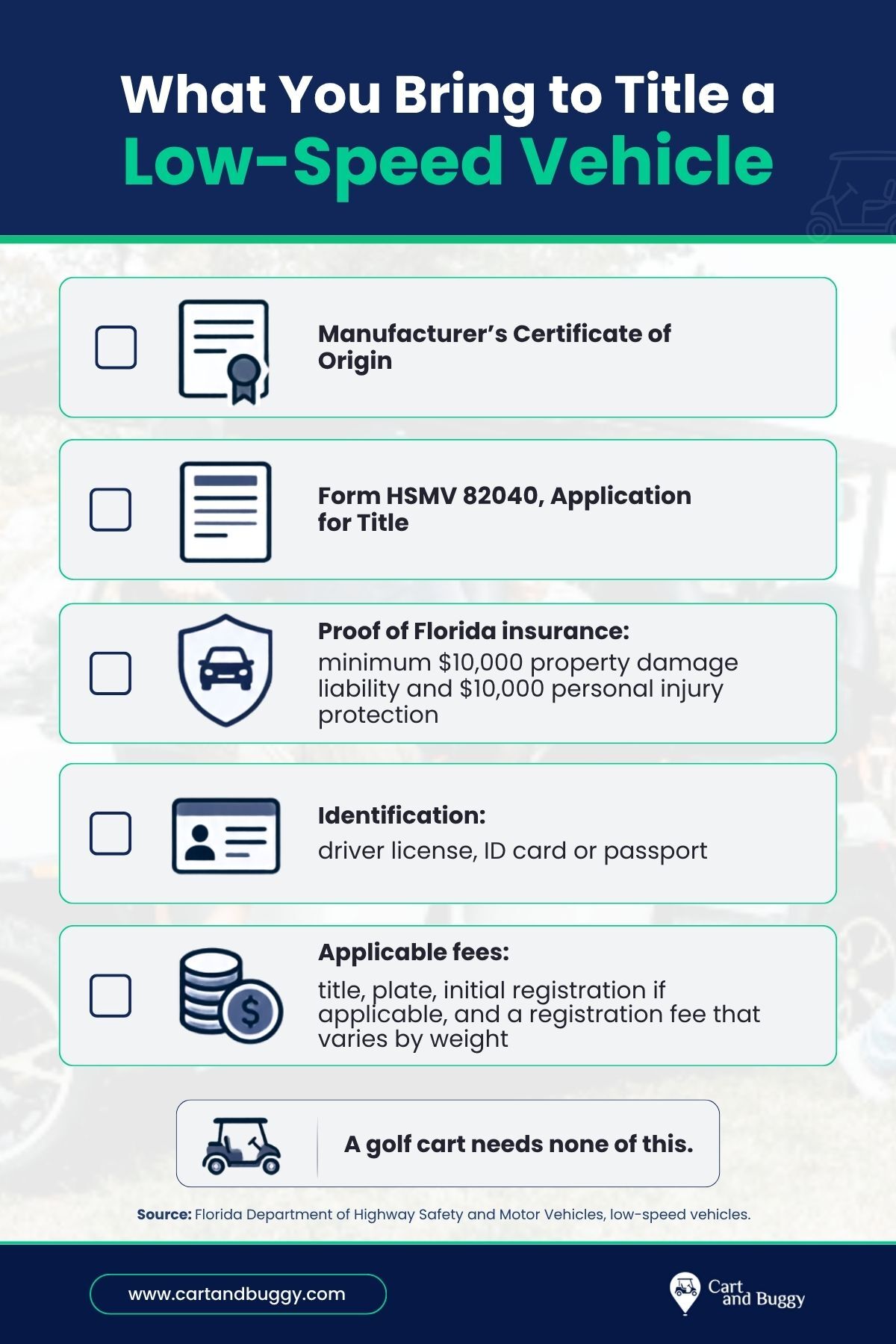
To title and register a low-speed vehicle, take the following to a Motor Vehicle Service Center:
- The Manufacturer’s Certificate of Origin
- Form HSMV 82040, the Application for Title
- Proof of Florida insurance, minimum $ 10,000 in property damage liability and $ 10,000 in personal injury protection
- Identification: driver’s license, ID card, or passport
- The applicable fees
The fees themselves are a title fee, a plate fee, an initial registration fee where applicable, and a registration fee that varies by the weight of the vehicle.
The document that trips people up
The Manufacturer’s Certificate of Origin is the one to think about before you buy rather than after.
It is the document that establishes the vehicle came from the factory as a low-speed vehicle, built to the federal standard. A cart sold as a golf cart does not have one for a low-speed vehicle, and no amount of upgrading afterwards produces one. This is the practical reason the buying decision and the registration decision are the same, made at the same moment, and why it is worth being clear about which you are buying before money changes hands.
Our guide to street legal carts and LSVs covers the build differences in more depth, and the general registration walkthrough covers the process outside Florida.
Does Your Local Government Get a Say?
Yes, and this is the part national articles leave out.
That same section allows a local governmental entity to enact an ordinance relating to golf cart operation and equipment that is more restrictive than the state list. When it does, it has to post appropriate signs or otherwise inform residents that the ordinance exists and will be enforced. Local rules can also cover golf cart operation on sidewalks alongside specific segments of municipal streets, county roads, or state highways.
The low-speed vehicle section gives the same power on the other side: a county or municipality may prohibit the operation of low-speed vehicles on any road under its jurisdiction.
The consequence for a buyer is simple and often missed. The state answer and the answer for your street are two different answers, and the second one is set at city hall. Before assuming a cart can be driven to the shops, find out what your municipality has designated, because a road with no designation is a road where the answer is no regardless of what your cart can do.
What the Exemption Does Not Do
Worth its own section, because “exempt” gets read as “unregulated,” and the two are not the same thing.
Exemption from title and tag says nothing about liability. If a cart is involved in an incident on a public road, the absence of a registration requirement does not make the driver less responsible for what happened. It only means the state has no record of the vehicle to check against. That cuts both ways, and it usually cuts against the owner, because a vehicle nobody registered is also a vehicle nobody insured.
It says nothing about who may drive, either. The age and identification rules in section 316.212 apply to a golf cart on a public road whether or not it carries a tag, and they are the rules most commonly broken in exactly the neighbourhoods where carts are most common.
And it says nothing about where. The designation requirement is the practical constraint on an exempt cart, and it is set locally, so two identical carts in two towns twenty minutes apart can have entirely different answers.
The insurance point, stated plainly
A golf cart carries no state insurance requirement. That is a fact about Florida law and not a recommendation.
Whether a homeowner policy responds to a cart, and under what circumstances, is a question for the insurer rather than for a dealer or for an article. The answer varies by carrier and by policy; it is specific to one household, and anybody who tells you what your policy covers without reading it is guessing. Ask, and ask for the answer in writing.
Two Vehicles That Look Identical
The reason this confuses so many buyers is that the two categories are visually indistinguishable in a showroom.
Park a golf cart next to a low-speed vehicle from the same manufacturer, and the differences are a windshield, seat belts, turn signals, a VIN plate, and a different piece of paper in the folder. The bodies can be the same, the seats can be the same, and the price gap is often smaller than people expect.
That similarity is exactly why the question has to be asked out loud rather than assumed from the look of the thing. A buyer who intends to drive on a 35 mph street and buys the car that looked the same has bought a vehicle that cannot legally be there, and no amount of paperwork afterwards fixes it.
A Short Test You Can Run Before Buying
Three questions, in this order, settle almost every case.
First, what is the vehicle’s top speed as built? Not with upgrades, not on a downhill. At or below 20 mph, it is a golf cart. Above 20 and up to 25, it is a low-speed vehicle, provided it was manufactured to the federal standard.
Second, does it have a VIN and a Manufacturer’s Certificate of Origin naming it a low-speed vehicle? If yes, the titling path is open. If no, it is a golf cart, and the exemption applies, with all the road limits that come with it.
Third, what has your city or county designated? This decides where you can actually drive either one, and it is the question that most often changes somebody’s mind about which cart to buy.
Where the answer points to a low-speed vehicle, it is worth checking what cart speeds actually mean in practice before ordering, because the 20 mph line is closer to a standard cart’s real-world speed than most buyers expect.
Decide the Cart Category Before Florida Decides It
The registration question resolves itself once the buying question is answered properly, because in Florida the paperwork follows the vehicle rather than the other way round. A cart bought for paths, a golf course, and a designated neighbourhood road needs no tag. A cart bought to run errands on a 35 mph street needs to have left the factory as a low-speed vehicle.
Cart and Buggy lists dealers by state, and you can see what is available from Florida dealers before you have the conversation. Ask any dealer, ours included, one question first: does this specific vehicle come with a Manufacturer’s Certificate of Origin as a low-speed vehicle? The answer decides everything after it.