
A standard golf cart goes about 12 to 15 mph, a street-legal low-speed vehicle is capped at 25 mph by law, and lifted or upgraded carts can go faster on private property. The speed you can legally use on a public road is limited to 25 mph for an LSV. How fast your cart goes depends on the motor, the controller, the battery voltage, the gearing, and any programmed speed limit. This guide explains the speeds by cart type, what sets the ceiling, whether you can safely make a cart quicker, and where the law draws the line.
How fast do golf carts go
Out of the box, a typical golf cart cruises at 12 to 15 mph, which is plenty for a course or a quiet neighborhood. A personal transportation cart often tops out near 19 mph. A street-legal LSV is built and limited to 25 mph, the federal ceiling for the category. Beyond that, only off-road or upgraded carts go faster, and not legally on public roads. So the honest answer to how fast a golf cart goes is: it depends on the type, and the law caps road use at 25 mph.
Speed by cart type
| Cart type | Typical top speed | Road use |
|---|---|---|
| Standard golf cart | 12 to 15 mph | Course and private property |
| Personal vehicle | up to about 19 mph | Limited, varies by area |
| Street-legal LSV | 25 mph | Roads posted 35 mph or less |
| Upgraded or off-road cart | 25 mph and up | Private property only |
The table shows the ceiling for each type, but the details behind those numbers are worth understanding before you buy or modify a cart.
Standard golf carts
A basic course or personal cart is geared and programmed for low speed, usually 12 to 15 mph. That is by design, since a cart on a course or a private path does not need more, and lower speed is safer around people. These carts often run on lead-acid batteries and modest motors. They are not built for the road, and pushing them faster strains components that were sized for gentle use. For most casual buyers, this speed is all they ever need.
Personal vehicles
A step up, the personal vehicle, or PTV, often tops out near 19 mph. Brands sell these as neighborhood carts, and they may be allowed on some low-speed streets depending on local rules, but they are not full LSVs. The slightly higher speed makes them feel quicker than a course cart while staying below the LSV threshold. If you are comparing carts for road-ish use, know that a PTV at 19 mph is not the same as a 25 mph LSV and may not be road-legal where you live.
Street-legal LSVs and the 25 mph cap
A street-legal low-speed vehicle is built and limited to 25 mph. That number is not arbitrary. It is the federal ceiling that defines the low-speed vehicle category and allows the cart on roads posted at 35 mph or less in most states. Carts from ICON dealers, Star EV dealers, Tomberlin dealers, and others hit this 25 mph mark and carry the safety equipment and VIN that road use requires. Stay at or below 25 mph, and the cart remains a legal LSV. Push past it, and the cart leaves the category.
Neighborhood electric vehicles
A neighborhood electric vehicle, like the models from Polaris GEM dealers, is also capped at 25 mph but built more like a small car, with car-like safety features and longer range. The speed is the same as any LSV, but the vehicle feels more substantial and is engineered for sustained road use. If you want road-going capability with a higher level of safety than a typical cart, an NEV is the route, though it costs more than a basic street-legal cart.
What controls a cart’s speed
Top speed comes down to a handful of parts working together. The motor sets the power available, the controller manages how that power is delivered, the battery voltage influences output, and the gearing determines how motor speed translates to wheel speed. On top of all that, many carts have a programmed speed limit set in the controller. A street-legal cart is deliberately limited to 25 mph in software and hardware to stay within the law, even if the parts could spin faster.
The role of the battery
The battery plays a part in speed and how long that speed lasts. Higher-voltage systems, like the 48-volt and higher setups on modern lithium carts, have more potential than older lead-acid carts, and lithium delivers consistent power as it drains, so the cart holds its speed better through a charge. A tired lead-acid pack sags toward the end, so the cart slows as the batteries deplete. Lithium carts from Evolution dealers and others tend to feel stronger and more consistent at speed than older lead-acid models.
Can you make a golf cart faster?
Yes, within limits. Common upgrades include a higher-output motor, a performance controller, a higher-voltage battery, changed gearing, and removing or raising a programmed speed limit. On private property, these let a cart go well beyond 25 mph. Shops and some dealers offer performance packages for exactly this. The catch is what it does to the cart’s legal status and safety, which is where buyers need to be careful before they start swapping parts for speed.
Where the law draws the line
This is the key point. Going past 25 mph removes the cart from the low-speed vehicle category. That can make it illegal to drive on the roads where LSVs are allowed, since it no longer meets the definition, and it can void the cart’s warranty and your insurance. In short, a faster cart can become a cart you cannot legally or safely drive on the road. Keep performance builds on private property, and keep road carts at their rated 25 mph.
Safety at higher speeds
Faster is not automatically better. Golf carts lack the crumple zones, airbags, and structure of a car, so higher speeds raise the risk in a crash or a sudden stop. Brakes, tires, and suspension sized for low speeds are stressed at higher ones. A cart doing 30 or more mph is a different and riskier vehicle than one at 15. If you want more speed for road use, the safer path is a true LSV at 25 mph or an NEV engineered with car-like safety, not a hot-rodded course cart.
Warranty and insurance risks
Beyond legality and safety, speed modifications carry financial risk. Many manufacturers void the warranty if you alter the motor, controller, or speed limit, so a costly repair later may not be covered. Insurance can be an issue too, since a cart modified beyond its legal class may not be covered in a claim, and an unregistered fast cart on the road compounds the problem. Before chasing speed, weigh the loss of warranty and coverage against the benefit, because the math often favors leaving a road cart as the maker built it.
Which Golf Cart brands and models feel quicker
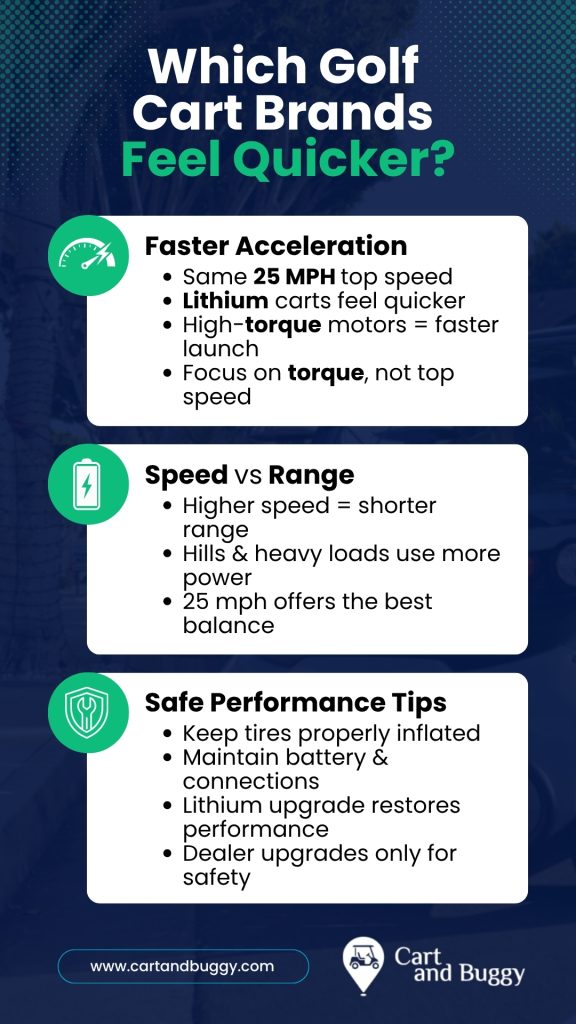
Among street-legal carts, all top out at the same 25 mph cap, so the difference is in how they get there and hold it. Lithium carts with higher-voltage systems, like many from ICON dealers and Evolution dealers, feel brisk and steady. Carts marketed with performance or high-torque motors accelerate harder, which matters more than top speed for hills and quick starts. If acceleration is what you want, ask the dealer about motor output and torque rather than top speed, since the legal ceiling is the same for every LSV.
Speed versus range trade-off
There is a trade-off worth knowing: driving faster uses more energy and cuts range. A cart pushed to its top speed will not go as far on a charge as one driven gently. Heavier loads and hills add to the draw. If you upgrade for speed, expect range to drop, and size the battery accordingly. For most buyers, the stock 25 mph LSV setup balances speed and range well, which is part of why the cap is sensible for everyday use.
How to safely get a little more
If your cart feels slow and you want a modest, safe improvement, start with the basics before any performance parts. Proper tire pressure, a healthy battery, and clean connections all help the cart reach its rated speed. Upgrading from a worn lead-acid pack to lithium can restore lost performance. If you still want more for private-property use, have a dealer or qualified shop do the work so it is done safely and you understand the effect on warranty and legality. For road use, the right answer is usually a proper LSV, not a modified cart.
How dealers set and adjust speed
The programmed speed limit is usually set at the factory or by the dealer to match the cart’s class. A street-legal cart is locked to 25 mph to keep it legal, while a course cart may be set lower. Some dealers can adjust settings within legal limits, for example, enabling the full 25 mph on an LSV that shipped set lower. Ask the dealer what the cart is set to and whether it can be configured, but be clear that raising a road cart above 25 mph crosses the legal line, which a reputable dealer will not do for street use.
What actually feels fast in a cart
Top speed is only part of the experience. Because a golf cart sits low, is open, and has no doors, even 20 to 25 mph feels quicker than the same speed in a car. Acceleration, the surge off the line, often matters more day to day than the top number, and a torquey lithium cart feels lively even at modest speeds. When you test drive, judge how the car feels at neighborhood speeds and on a hill rather than chasing the highest number, since that is the experience you will live with.
Speed, kids, and new drivers
If younger or new drivers will use the cart, speed settings matter for safety. Many carts can be set to a lower limit, which is wise for teens learning on private property, and some dealers can dial in at a reduced speed. On public roads, normal licensing and age rules apply to an LSV, so a learner should practice on private ground first. Matching the speed setting to the driver, rather than always running the cart at its ceiling, is a simple safety step a dealer can help you configure.
Final Thoughts
Whether your golf cart tops out at 15 mph or a street-legal 25 mph, the real goal is choosing a vehicle that matches how you’ll use it. Speed has its place, but safety, reliability, and everyday practicality matter far more in the long run. Cart and Buggy, we recommend buying for your needs rather than chasing the highest number on the spec sheet. A well-chosen cart will provide years of dependable service, and that’s what truly makes it a great investment.