
A new cart costs what it costs because you are buying four things at once: a lithium battery pack, a small automotive drivetrain, a federally mandated equipment list if the cart is road legal, and an imported bill of materials that now carries tariffs. Pull those apart, and the number stops looking arbitrary.
TL;DR
Most of a new golf cart’s price sits in four places. The battery pack is the largest single line, and lithium packs are priced off the same cell market that supplies electric cars. The drivetrain is small-car hardware: an AC induction motor, a high-amperage controller, hydraulic brakes, a helical-gear transaxle.
If the cart is a street-legal low-speed vehicle, federal standard FMVSS 500 (49 CFR 571.500) requires twelve items of equipment that a course cart does not carry, from turn signals to a conforming windshield to a VIN. Tariffs then add to the imported parts, and Colorado adds ownership tax based on the original sticker for years afterward.
What You Are Actually Paying For Inside the Body Panels
Open a manufacturer spec sheet instead of a dealer flyer, and the hardware list reads like a small car. E-Z-GO publishes the build for its Liberty line: a welded steel frame with a powder-coat finish, an injection-molded TPO front body, a thermoform ABS rear body, an AC induction motor rated at 11.7 hp (8.7 kW), a 235 amp AC controller, self-compensating rack and pinion steering, leaf springs with hydraulic shock absorbers, and a differential with helical gears on a 16.99:1 forward ratio. All of that appears on E-Z-GO’s own Liberty and Liberty LSV specification sheet, document 82706-G8, revised May 2025.
None of those parts is exotic. Each one is a real component with a real supplier, and each one has to survive rain, cart-path gravel, road salt in Jefferson County, and a decade of sun at 5,280 feet. Cheap parts fail that test.
The curb weight tells the same story. E-Z-GO lists the four-passenger Liberty at 960 pounds and the street-legal Liberty LSV at 1,040 pounds. Something has to carry that mass, stop it, and steer it, which is why you get four-wheel hydraulic brakes on the LSV rather than the dual rear drums fitted to the non-street version.
Why Does a Street-Legal Cart Cost More Than a Course Cart?
Because a road-legal low-speed vehicle carries an equipment list written into federal law, and a course cart does not. Federal Motor Vehicle Safety Standard No. 500, at 49 CFR 571.500, requires every low-speed vehicle to be built with all of this:
| Required on every LSV | Detail in the standard |
| Headlamps | Front lighting, always fitted |
| Turn signal lamps | Front and rear |
| Taillamps | Rear lighting |
| Stop lamps | Braking signal, separately required |
| Red reflex reflectors | Each side and at the rear |
| Mirrors | Driver’s-side exterior, plus a passenger-side exterior or an interior mirror |
| Parking brake | Separate from the service brake |
| Windshield | Conforming to the glazing standard at 49 CFR 571.205 |
| VIN | Meeting 49 CFR part 565 |
| Seat belts | Type 1 or Type 2 assembly at every designated seating position |
| Rear visibility | Added later, per FMVSS No. 111 |
| Alert sound | Added later, per 49 CFR 571.141 |
Twelve required items. Not a trim package, not an upsell the dealer invented.
The federal definition of the vehicle class sits one section earlier, at 49 CFR 571.3: four wheels, a top speed over 20 mph and no more than 25 mph on a paved level surface, and a gross vehicle weight rating under 3,000 pounds. Clear that bar and the manufacturer is building a motor vehicle, with the certification and recall obligations that come with one.
The same platform, two prices
E-Z-GO’s own spec sheet is the cleanest illustration we have seen, because it puts both versions of one platform side by side. The standard Liberty tops out around 19 mph on level ground, runs a single lithium module, and brakes on dual rear drums. The Liberty LSV runs twin lithium modules, hits 25 mph, and lists as standard equipment an operator protective structure canopy, a pedestrian warning system, a rear-view mirror with integrated display, a backup camera, lap belts, side view mirrors, a center high mount brake light, four-wheel hydraulic brakes, and turn signals with a horn.
Read that list again and price it in your head. Doubling the battery alone would move the number. Everything after it is additional.
The voluntary standard on top of the federal one
Some builders go past the federal floor. Club Car’s low-speed vehicle brochure COMM0072, published in 2020, sets out a comparison table: a golf car is limited to 15 mph with no lighting requirement, a personal transport vehicle runs to 20 mph with headlights and brake lights, and an LSV runs to 25 mph with the full federal kit. The brochure then lists what the voluntary SAE J2358 standard adds beyond FMVSS 500, including a third brake lamp, a horn, seat belt anchorage load testing, a roof crush test at 1.5 times vehicle weight, and a crash test with contained batteries. Club Car states its LSVs meet J2358 as well as the federal standard.
That is a build decision, and it shows up in the price. When two carts look identical in a showroom and one costs noticeably more, this is often the reason.
How Much of the Price Is the Battery?
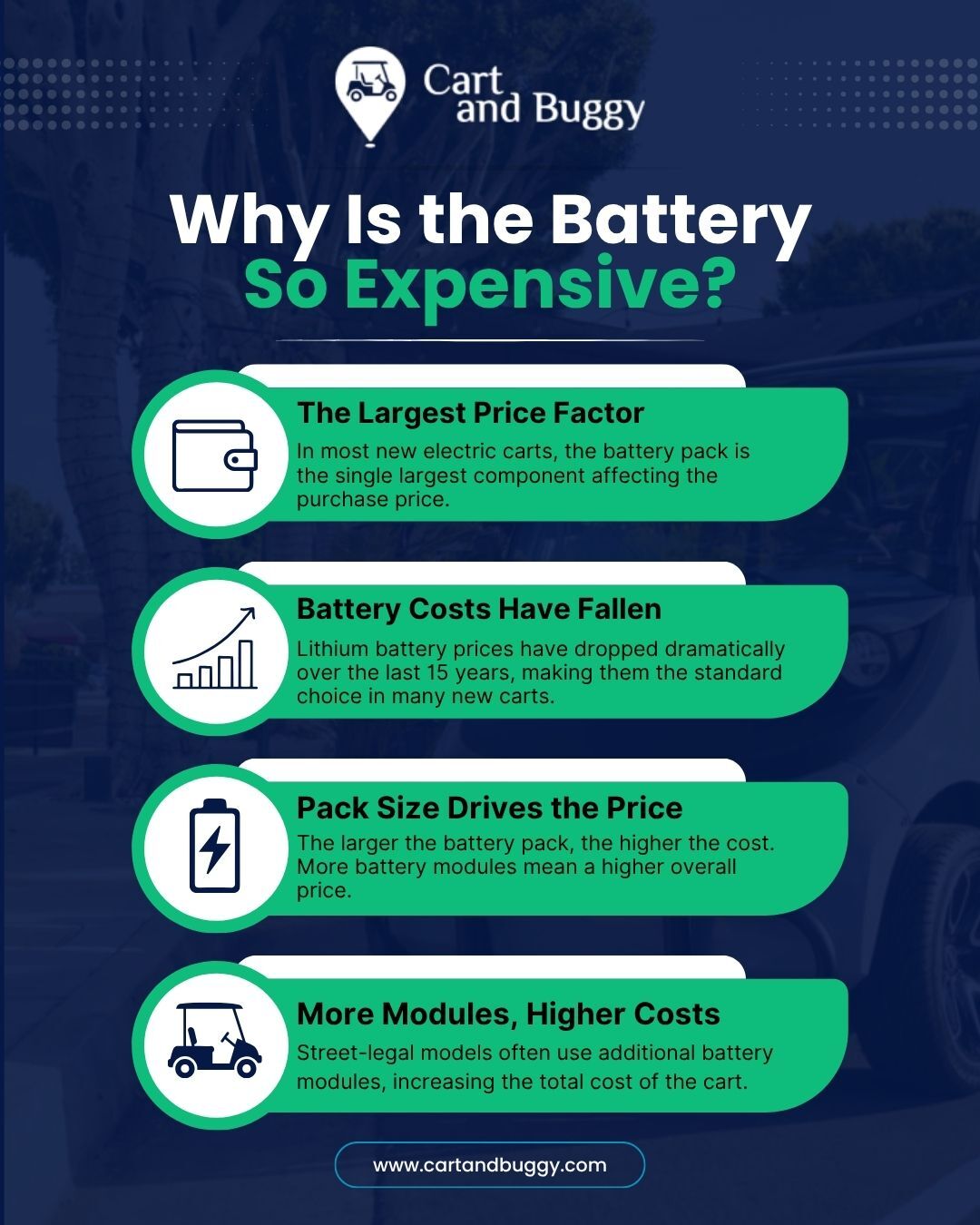
The pack is the largest single line in most new electric carts, and it is priced off the same cell market that supplies electric cars. The US Department of Energy’s Vehicle Technologies Office put the cost of a light-duty EV lithium-ion battery pack at $139 per kWh in 2023, on a usable-energy basis, for production at scale of at least 100,000 units a year, in 2023 constant dollars. That figure is down 90 percent from $1,415 per kWh in 2008. DOE built the estimate with Argonne National Laboratory’s BatPaC modeling tool and published it on 5 August 2024.
Two things follow from that. Cells got dramatically cheaper over fifteen years, which is why lithium moved from an exotic option to the default on most new carts. And car makers do not buy at the 100,000-unit-a-year scale DOE modeled, so nobody in this industry is paying the number in that headline.
What we can say plainly: pack size is the lever. E-Z-GO fits one lithium module to the Liberty and two to the Liberty LSV. Whatever a module costs a manufacturer, a street-legal cart on that platform starts with twice as many of them.
We cut a specific dollar figure for a cart-sized pack from this article. The widely quoted annual pack price index is a paid subscription product, and the numbers circulating in blog posts are second-hand summaries of it. A price we cannot open and read is not a price we will print.
Tariffs Reach the Cart Before It Reaches the Lot
Golf carts have their own line in the tariff book. Per the USITC’s Harmonized Tariff Schedule of the United States, they sit under heading 8703.10, “Vehicles specially designed for traveling on snow; golf carts and similar vehicles,” with statistical breakout 8703.10.50.30 for golf carts at a general duty rate of 2.5 percent.
That 2.5 percent is the baseline, and it is the smallest part of the story. Section 301 duties stack on top for goods from China, and the September 2024 modification notice from the Office of the United States Trade Representative moved several inputs a cart depends on. Reading the annex of that Federal Register notice, published 18 September 2024:
| Input | HTSUS subheading | Section 301 rate | Timing |
| Lithium-ion batteries, other than EV primary packs | 8507.60.0020 | 25% | 2026 |
| Permanent magnets | 8505.11.00 | 25% | 2026 |
| Parts of lead-acid batteries, including separators | 8507.90.40 | 25% | 2024 |
| Steel and aluminum products | various | 25% | 2024 |
The notice sets the timing rule in its DATES section: increases marked 2024 apply to products entered for consumption on or after 27 September 2024, and increases marked 2025 and 2026 apply to products entered on or after 1 January of that year.
Line one of that table is the one buyers felt this year. A lithium pack in a golf cart is not the primary battery of a passenger EV under subheadings 8703.40 through 8703.80, so it falls in the “other” basket at 8507.60.0020, and that basket went to 25 percent for entries on or after 1 January 2026. Permanent magnets landed in the same 2026 tranche, and permanent magnets are what make a compact traction motor compact.
Steel and aluminum moved earlier, in September 2024. Frames, roof supports, and wheels all come out of that bill of materials.
None of this means every cart on a Colorado lot carries every one of those duties. Origin decides it, and a dealer can tell you where a given model is built and where its pack is sourced. Ask. It is a fair question and a good dealer answers it without flinching.
Small Production Runs, Car-Sized Engineering Bills
A carmaker spreads crash testing and tooling across hundreds of thousands of units a year. Cart builders spread a smaller version of the same bill across a far smaller run, and the per-unit share is correspondingly larger. Add a dealer network that has to stock parts, train technicians, and honor warranty work, and the retail price carries costs that never appear as a part on the vehicle.
Model variety works the same way. A single platform sold in four trim packages, seven body colors, four seat colors, and multiple wheel and tire combinations, which is exactly how E-Z-GO configures the Liberty, means shorter runs of each configuration. Choice is expensive to manufacture.
The Colorado Costs That Arrive After the Sticker
Registration is where a Front Range buyer meets the second half of the price. The Colorado Division of Motor Vehicles defines a low-speed electric vehicle as self-propelled, primarily electric, with at least three wheels on the ground, not steered by handlebars, and showing manufacturer compliance with 49 CFR 565 or a seventeen-character VIN, on its specialized vehicles page. Meet that and you title and register through your county clerk and recorder like any other vehicle.
Then comes specific ownership tax, and this is the part that surprises people in Douglas County and Larimer County alike. Colorado bases it on the original sticker, not on what the cart is worth today.
Per the Colorado DMV’s taxes and fees page, Tax Class C taxable value is 85 percent of the original MSRP, and the annual assessment steps down from there:
| Registration year | Assessment on the taxable value |
| Year 1 | 2.1 percent |
| Year 2 | 1.5 percent |
| Year 3 | 1.2 percent |
| Year 4 | 0.9 percent |
| Years 5 to 9 | 0.45 percent |
| Year 10 | $3.00 flat |
Work through what that means. Two carts with different stickers do not differ only on the day of purchase. The gap in taxable value follows the more expensive cart every year it stays registered, because the original taxable value is fixed at 85 percent of the original MSRP and never falls as the vehicle ages.
Smaller fees ride along on the same registration card, and the same DMV page gives each one a statutory basis: a clerk hire fee under C.R.S. 42-1-210, an emergency medical services fee under C.R.S. 42-3-304(21), a peace officer training fee, plate and tab material fees, and a weight-based registration base fee under C.R.S. 42-3-306(2)(b)(I).
Individually trivial. Worth knowing about before you sign.
Insurance is the last line. Colorado requires liability coverage on registered vehicles, and a policy written for a cart used on private property is not the same policy as one covering public roads in Grand Junction or Steamboat Springs.
Where a Buyer Can Genuinely Take Money Out
Match the cart to where you will actually drive it. If your route never leaves a gated community in Castle Rock at 15 mph, you are paying for an equipment list you will not use. If you plan to cross a 35 mph road in Fruita or Palisade, the LSV build is not optional, and trying to bolt it on afterward is the expensive path.
Pack size is the second lever. Range you never use is money sitting in the bed of the cart. Be honest about your longest regular trip, in August heat and in February, and buy to that.
Third, compare across more brands than the big names. Builders like Advanced EV sell the same equipment for less, and our guide to electric golf carts covers how the powertrains differ under the seat. STAR EV and E-Z-GO have their own category pages alongside it.
When you are ready to shop locally, the listings for golf cart dealers in Colorado put dealers in one place.
Finally, get the paperwork right the first time. Our walkthrough on registering a cart as an LSV covers the sequence, and the current price ranges by brand tier give you a sanity check on any quote.
Reading a Cart Quote Line by Line
Take the quote a dealer hands you and sort every line into one of four buckets: the battery, the drivetrain and chassis, the federally required road equipment, then dealer and delivery charges. Anything that will not sort belongs in a question.
Four questions, and the answers should come without hesitation:
- What is the pack, and how many modules?
- Is the cart certified to FMVSS 500, or built only to the course-cart spec?
- Where is it built, and where is the pack sourced?
- What will the registration paperwork look like at my county clerk?
A dealer who answers all four clearly is worth more than a $500 discount from one who will not. If you want to see who sells what near you before you start that conversation, Cart and Buggy list dealers by state and by brand.